 Skip to content
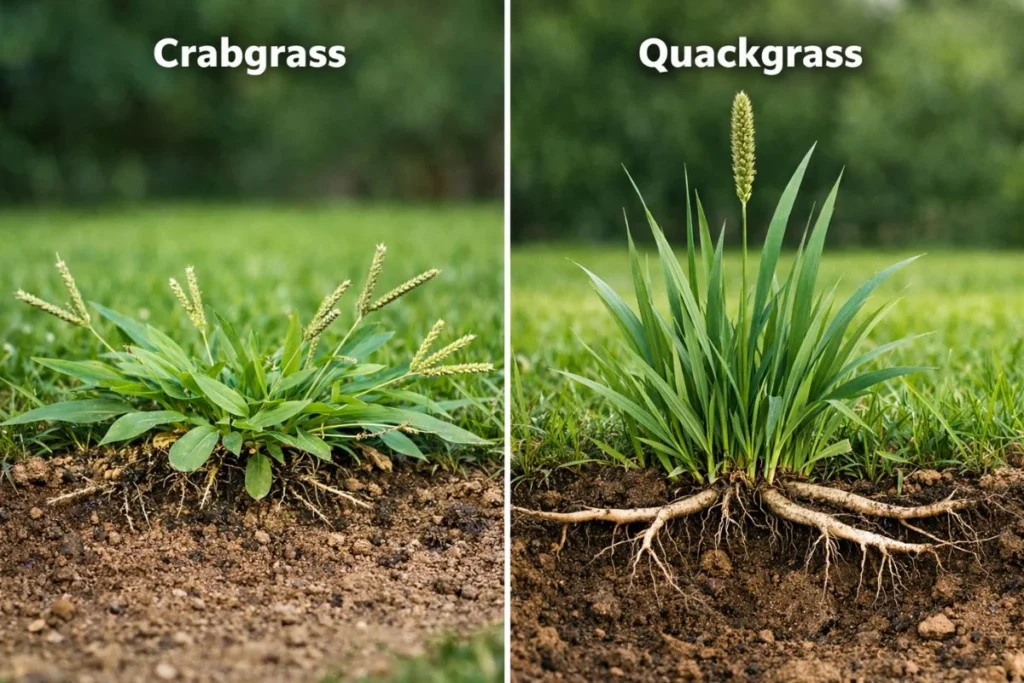
A few years ago, I treated what I believed was crabgrass in a client’s cool-season lawn. I used the right product, applied it at the right rate, and waited. Two weeks later, the weed was still standing. The problem was not the product. The problem was identification. It was quackgrass, not crabgrass. That mistake cost time, money, and caused stress for the homeowner.
This is a common situation. Many lawns across the United States struggle with grassy weeds that look alike but behave very differently. Grassy weeds behave differently from broadleaf weeds, and the control method changes based on the weed type. If you are unsure how grassy weeds differ from broadleaf weeds, read our complete guide on what is a broadleaf weed for a clear breakdown. If you confuse quackgrass vs crabgrass, your control plan will fail. One spreads by seed and dies each year. The other spreads underground and returns stronger. In this guide, I will show you how to tell the difference clearly, how to treat each one correctly, and how to prevent them from coming back.
- What Is Crabgrass?
- What Is Quackgrass?
- Quackgrass vs Crabgrass: Side-by-Side Comparison
- Step-by-Step Weed Identification Guide
- Why Your Treatment May Have Failed
- How to Control Crabgrass
- How to Control Quackgrass
- Regional Timing Guide (United States)
- Lawn Recovery After Weed Removal
- Preventing Both Weeds Long-Term
- What to Do Next
- Frequently Asked Questions
- Conclusion
What Is Crabgrass?
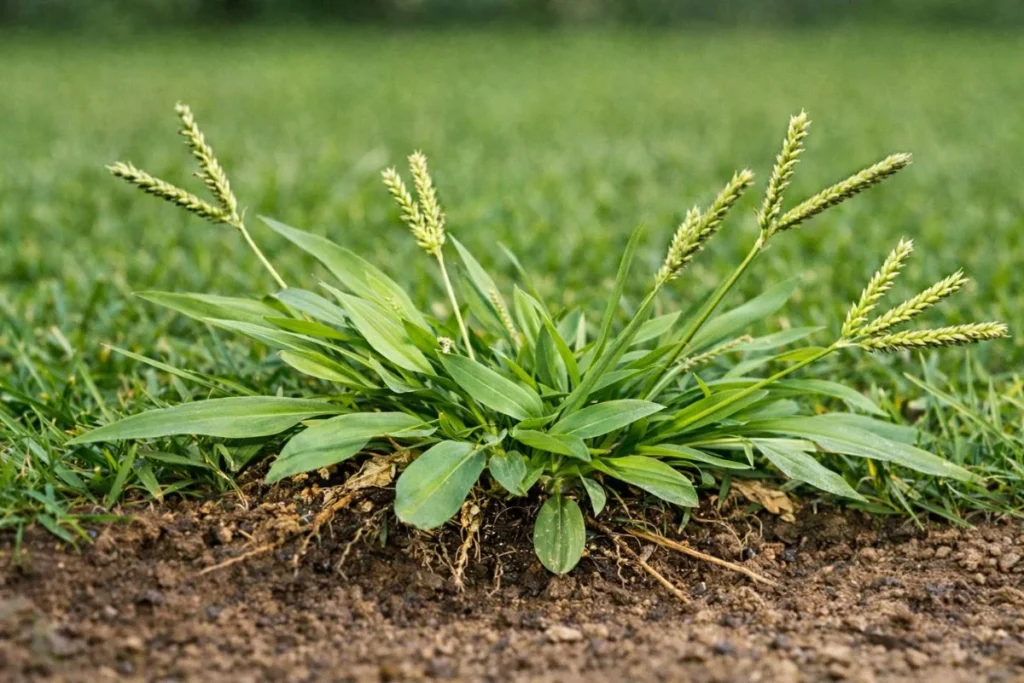
Crabgrass is a warm-season annual grassy weed. Its botanical name is Digitaria sanguinalis. Another common species in US lawns is Digitaria ischaemum.
Crabgrass grows low to the ground. The stems spread outward from the center.
Key traits of crabgrass
- Life cycle: Annual
- Growth habit: Low and spreading
- Roots: Shallow and fibrous
- Season: Late spring through summer
- Spread method: Seeds
- Color: Light green
Crabgrass grows from seed each year. It dies after the first hard frost. Before dying, it drops thousands of seeds.
It thrives in thin lawns, compacted soil, and hot weather.
What Is Quackgrass?
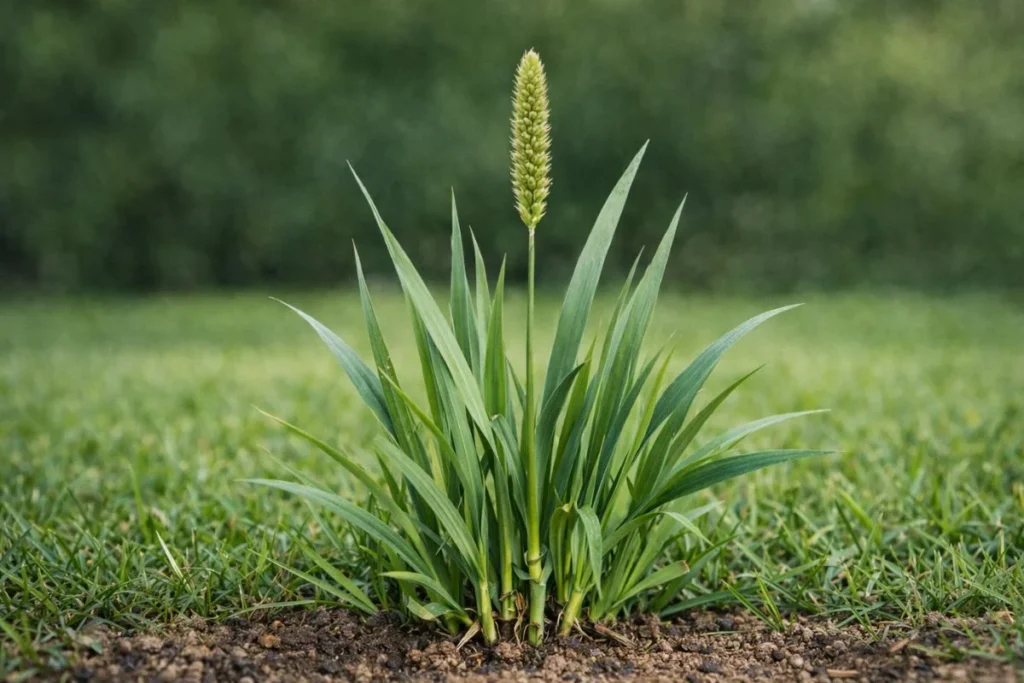
Quackgrass is a cool-season perennial grassy weed. Its botanical name is Elymus repens.
It grows upright and blends into turfgrass.
Key traits of quackgrass
- Life cycle: Perennial
- Growth habit: Upright
- Roots: Thick underground rhizomes
- Season: Active in spring and fall
- Spread method: Rhizomes and seeds
- Color: Blue-green
Even small rhizome pieces can regrow.
Unlike crabgrass, quackgrass survives winter and returns each year.
Quackgrass vs Crabgrass: Side-by-Side Comparison
| Feature | Crabgrass | Quackgrass |
|---|---|---|
| Life cycle | Annual | Perennial |
| Growth pattern | Low spreading | Upright |
| Root system | Shallow | Rhizomes |
| Peak season | Summer | Spring & Fall |
| Spread method | Seeds | Rhizomes & seeds |
| Removal difficulty | Moderate | High |
Quackgrass is harder to remove because of underground rhizomes.
Quick Takeaway: Crabgrass vs Quackgrass
- Low and spreading in summer = likely crabgrass
- Upright growth with underground runners = likely quackgrass
- Dies after first frost = crabgrass
- Returns every year = quackgrass
- Prevent with early spring pre-emergent = crabgrass
- Spot treat and reseed = quackgrass
Step-by-Step Weed Identification Guide
If you are unsure which weed you have, follow this order:
- Look at growth pattern.
- Flat and spreading = likely crabgrass
- Tall and upright = likely quackgrass
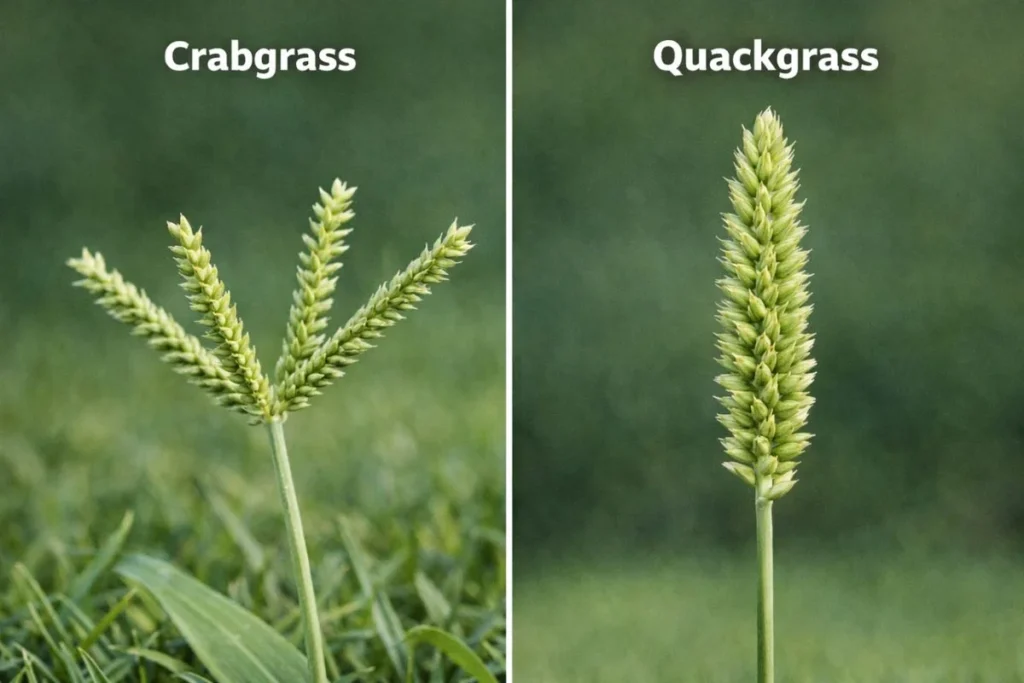
- Check the seedhead.
- Finger-like spikes = crabgrass
- Single upright spike = quackgrass
- Look at the base of the leaf.
- Clasping auricles = quackgrass
- No auricles = crabgrass
- Pull a small plant.
- Shallow roots = crabgrass
- Long white rhizomes = quackgrass
Correct identification comes first. Control comes second.
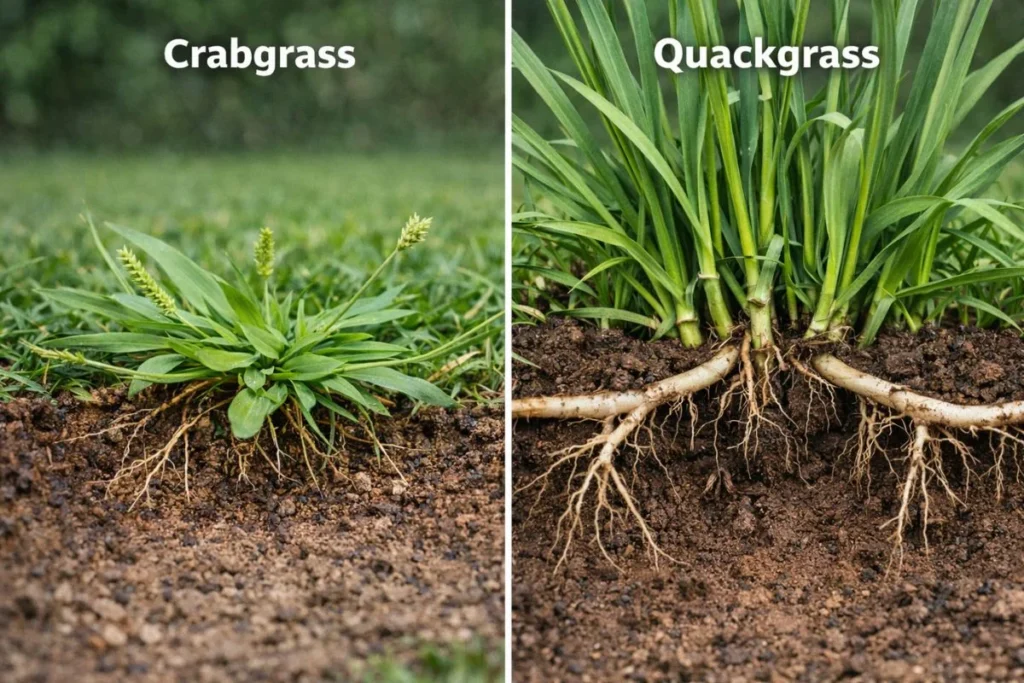
At-a-Glance Identification
Crabgrass
- Grows flat and spreads outward
- Appears in hot summer
- Finger-like seedheads
- Shallow roots
Quackgrass
- Grows upright
- Appears in cool seasons
- Single spike seedhead
- Underground rhizomes
Why Your Treatment May Have Failed
Many homeowners search this comparison after a product fails.
Common reasons include:
- You treated quackgrass with crabgrass killer
- Crabgrass was already mature
- Pre-emergent was applied too late
- Soil temperature was above 55°F
- Heavy rain reduced effectiveness
Post-emergent crabgrass control works best when plants are young.
If your treatment failed, misidentification is often the cause.
Common Homeowner Mistake
Many homeowners assume every grassy weed is crabgrass. They apply pre-emergent too late or spray selective herbicide on quackgrass. The result is wasted money and lawn damage.
Correct identification before treatment saves time, money, and frustration.
How to Control Crabgrass
1. Prevent It in Early Spring
Apply pre-emergent herbicide when soil reaches 50 to 55°F.
Common active ingredients include:
- Prodiamine
- Dithiopyr
- Pendimethalin
These prevent seeds from sprouting.
2. Treat Young Plants
Post-emergent control works best when crabgrass has 1 to 3 leaves.
3. Strengthen Your Lawn
Mow at proper height. Avoid cutting too short. Thick turf blocks sunlight and reduces germination.
How to Control Quackgrass
1. Spot Treat Carefully
Non-selective herbicides like glyphosate are commonly used for spot treatment.
They kill both weed and turfgrass. Apply with precision.
2. Remove Rhizomes
If digging, remove all underground stems.
3. Reseed Quickly
Repair bare areas to prevent reinfestation.
Selective herbicide options for quackgrass are limited and often inconsistent in cool-season lawns.
Regional Timing Guide (United States)
Northern States
- Apply crabgrass prevention in early to mid spring
- Quackgrass grows strongest in cool seasons
Southern States
- Apply pre-emergent earlier
- Crabgrass season lasts longer
Transition Zone
- Monitor soil temperature closely
Using a soil thermometer gives better timing than calendar dates.
Seasonal Action Plan
| Season | What to Watch | Action Step |
|---|---|---|
| Early Spring | Soil near 50–55°F | Apply crabgrass pre-emergent |
| Late Spring | Upright grassy growth | Check for quackgrass |
| Summer | Low spreading weed | Spot treat young crabgrass |
| Fall | Thin lawn areas | Overseed and strengthen turf |
Lawn Recovery After Weed Removal
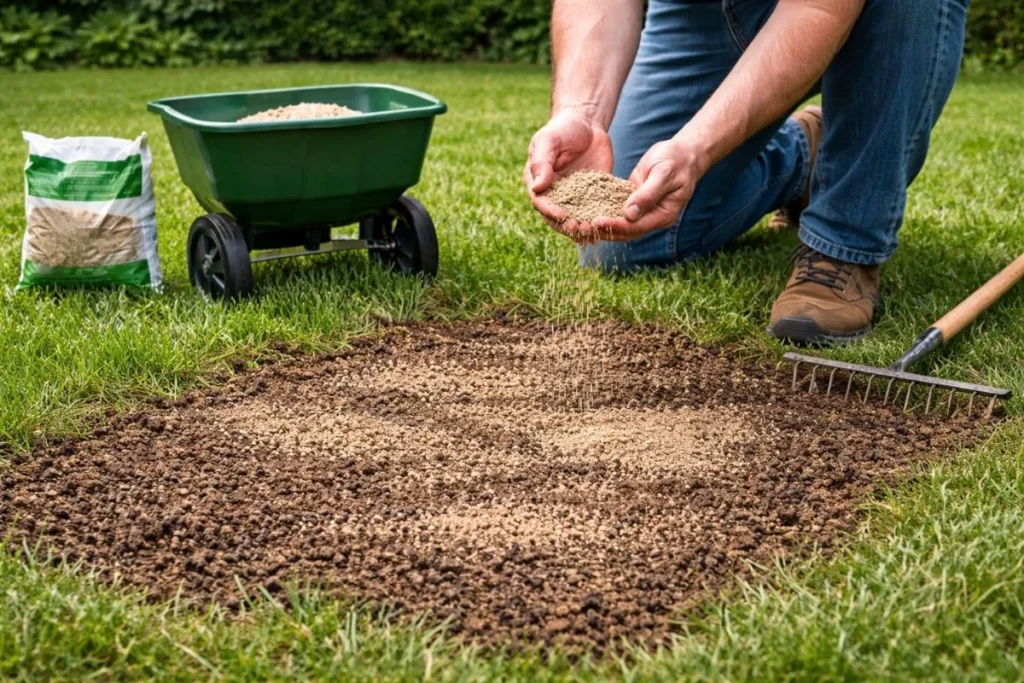
After killing crabgrass:
- Remove dead material
- Overseed thin areas
- Keep soil moist
After killing quackgrass:
- Wait 7 to 14 days
- Remove dead turf
- Add topsoil if needed
- Reseed
Avoid using pre-emergent before overseeding.
Preventing Both Weeds Long-Term
If weeds keep returning, your lawn may be weak.
Improve turf health by:
- Aerating compacted soil
- Fertilizing based on soil test
- Overseeding in fall
- Maintaining proper mowing height
Dense turf is your best defense.
What to Do Next
If your lawn has crabgrass, focus on early spring prevention next season.
For quackgrass, plan on careful spot treatment followed by reseeding.
Still unsure about the weed? Recheck the seedheads and root structure before applying any products.
Correct action now saves money later.
Frequently Asked Questions
Which is worse, quackgrass or crabgrass?
Quackgrass is usually harder to remove because it spreads underground.
Does quackgrass die in winter?
No. It survives and returns.
Will crabgrass return next year?
Yes, if seeds remain in the soil.
Conclusion
After working with cool-season lawns and studying university extension guidance, I have learned that most grassy weed problems begin with confusion. When homeowners slow down and identify the weed first, everything changes. Crabgrass requires early prevention and proper timing. Quackgrass requires patience and careful removal because of its rhizomes. The real long-term solution is not just killing weeds, but building a dense, healthy lawn that leaves little space for them to grow. When you focus on correct identification, proper timing, and turf strength, both crabgrass and quackgrass become manageable instead of frustrating.