
- Understanding the Difference Between Flood Lights and LED Flood Lights
- Energy Consumption and the Economics of Operating Cost
- Maintenance, Lifespan, and the Cost of Keeping Lights Working
- Light Quality, Visibility, and Security Considerations
- Upfront Cost Versus Long-Term Value
- Installation, Controls and Compatibility Issues
- How Property Owners Should Decide Between the Two
Outdoor lighting rarely commands much attention until a parking lot feels too dark, a loading area becomes difficult to monitor, or an aging fixture begins generating repair bills. For property owners, flood lighting is less a decorative decision than an operating decision that affects visibility, energy use, maintenance spending, and security. The market, however, can be confusing because the term “flood light” describes a type of broad-beam fixture, while “LED flood light” describes a flood fixture built around a particular lighting technology. That distinction matters when owners are comparing replacement costs, expected service life, and long-term electricity consumption. A lower purchase price can sometimes conceal higher operating expenses, while a more expensive fixture can produce measurable savings over several years. Understanding those tradeoffs helps owners make lighting investments based on total performance rather than sticker price alone.
Thank you for reading this post, don't forget to subscribe!- Understanding the Difference Between Flood Lights and LED Flood Lights
- Energy Consumption and the Economics of Operating Cost
- Maintenance, Lifespan, and the Cost of Keeping Lights Working
- Light Quality, Visibility, and Security Considerations
- Upfront Cost Versus Long-Term Value
- Installation, Controls and Compatibility Issues
- How Property Owners Should Decide Between the Two
Understanding the Difference Between Flood Lights and LED Flood Lights
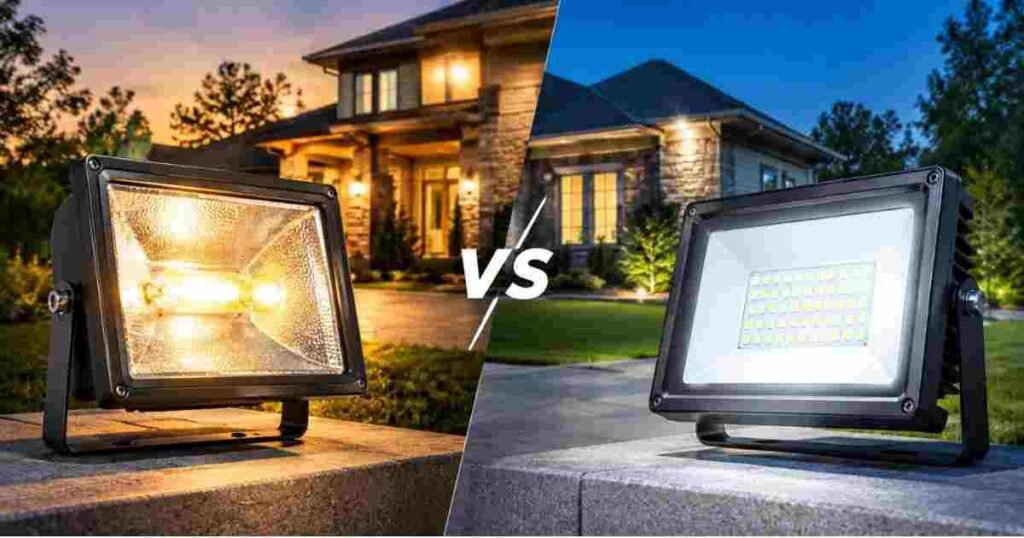
A flood light is fundamentally a fixture designed to spread illumination across a relatively wide area. Traditional flood lights have historically used technologies such as halogen, metal halide, high-pressure sodium, and other high-intensity discharge lamps. These systems became common in parking areas, building perimeters, sports facilities, warehouses, and commercial yards because they could produce substantial amounts of light from relatively few fixtures. The term therefore refers more to the lighting application than to the underlying source of illumination. An LED flood light performs the same broad-area function but uses light-emitting diodes rather than a conventional lamp and ballast arrangement. That difference in technology can have significant consequences for electricity consumption, maintenance intervals, startup behavior, and lighting quality.
Traditional flood lighting systems were often designed around replaceable bulbs, reflectors, and ballasts, with each component affecting how much useful light reached the target area. Metal halide fixtures, for example, can deliver strong initial output but may gradually lose brightness as the lamp ages. High-pressure sodium fixtures can operate efficiently compared with older incandescent technologies, but their yellow-orange color can make visual identification more difficult in some settings. Halogen flood lights provide relatively clean color but generally consume substantial energy and generate considerable heat. LED fixtures approach the same task differently by using arrays of semiconductor light sources paired with optics and electronic drivers. As a result, LEDs can direct light more precisely while converting a larger proportion of electrical energy into usable illumination.
Understanding the underlying technology is only the beginning of the buying process. Property owners also need to compare fixtures based on mounting height, beam spread, required light output, operating hours, and exposure to weather. Small differences in specifications can lead to meaningful changes in performance once a fixture is installed, especially across larger exterior spaces. Reviewing available configurations side by side can therefore make selection easier. Property owners researching the market can turn to retailers such as BuyRite Electric, an online source for lighting, electrical supplies, and tools, to explore high-output flood lights for broad outdoor coverage alongside weather-ready LED flood lights for security and landscape applications. Comparing these options can highlight differences in wattage, beam control, fixture construction, and intended use. The goal is to select lighting that delivers the right balance of coverage, durability, efficiency, and long-term operating performance for the property. This approach helps owners make decisions based on practical performance rather than technology labels alone.
Energy Consumption and the Economics of Operating Cost
Energy use is one of the clearest distinctions between many conventional flood lights and modern LED alternatives. Traditional high-output fixtures can draw significant wattage because older lighting technologies convert a meaningful share of their electrical input into heat rather than visible light. LEDs generally require fewer watts to produce a comparable level of useful illumination, particularly when the fixture’s optics are designed to direct light toward the intended surface. For a property with only one or two fixtures, the savings may appear modest on a monthly utility statement. For a warehouse complex, apartment community, retail center, or industrial property with dozens of fixtures operating every night, the difference can become substantial. Owners should therefore evaluate annual kilowatt-hour consumption rather than relying solely on the wattage printed on a product label.
The economics become more important as operating hours increase. A flood light used occasionally over a residential garage has a very different cost profile from a fixture that runs 12 hours every night throughout the year. A 250-watt reduction across 20 fixtures would eliminate 5,000 watts of connected lighting load whenever the system is operating. If those lights run thousands of hours annually, the avoided electricity use can materially offset the upfront cost of replacement. Local utility rates also influence the calculation because the financial value of each kilowatt-hour saved varies by market. Property owners evaluating a retrofit should estimate annual operating hours, electricity rates, and expected wattage reduction before judging whether a particular upgrade is economical.
Energy savings also interact with other building systems in ways that are easy to overlook. Conventional fixtures that release substantial heat can add thermal load in partially enclosed areas, equipment rooms, or covered structures. Outdoor applications are less affected, but reduced heat production may still improve the working environment around fixtures and electrical components. Lower connected wattage can also reduce demand on circuits, provided the installation is properly engineered and code compliant. In large commercial projects, reduced electrical load may create more flexibility for future equipment or lighting additions. Energy efficiency, in other words, is not merely an environmental characteristic but a factor that can shape broader operating and infrastructure decisions.
Maintenance, Lifespan, and the Cost of Keeping Lights Working
Maintenance frequently determines whether an inexpensive lighting system remains inexpensive over time. Traditional flood lights may require periodic lamp replacement, and some systems also rely on ballasts or other components that can fail independently. Replacing a lamp mounted 25 feet above a parking lot is not comparable to changing a bulb in a table lamp. The property owner may need a lift, a qualified technician, traffic control or scheduled access to an area that cannot be disrupted during normal operations. Those labor and access costs can exceed the price of the replacement lamp itself. Properties with difficult-to-reach fixtures therefore have a strong incentive to reduce the frequency of maintenance visits.
LED flood lights typically offer longer rated service lives than many conventional alternatives, although the exact lifespan depends on operating temperature, driver quality, fixture construction, and environmental conditions. LEDs also tend to lose output gradually rather than failing in the same way as a conventional lamp. Manufacturers commonly describe LED life in terms of lumen maintenance, which indicates how much light the fixture is expected to retain after a given number of operating hours. That approach can make replacement planning more predictable, but it does not mean every LED fixture will perform equally well. Low-quality drivers, poor thermal management, or inadequate weather sealing can shorten useful life dramatically. Property owners should therefore evaluate warranties, product certifications, and manufacturer reputations rather than treating the word “LED” as a guarantee of durability.
Maintenance planning should also account for the number and location of fixtures across the property. A site with 40 exterior lights may benefit from scheduled group replacement because it reduces repeated service calls and keeps illumination levels more consistent. LEDs can extend the interval between those interventions, which may simplify budgeting and reduce disruptions. However, integrated LED fixtures sometimes require replacement of the entire unit rather than a single lamp when the driver or light engine reaches the end of its useful life. That can increase the cost of an individual repair even while reducing the number of repairs required over time. The practical question is therefore whether the expected reduction in maintenance frequency outweighs the higher cost of replacing a complete fixture when service is eventually needed.
Light Quality, Visibility, and Security Considerations
Lighting performance should be judged by what people can actually see, not simply by the number of watts a fixture consumes. Traditional lighting technologies differ significantly in color rendering, color temperature, uniformity, and the way they distribute light over a surface. A bright fixture can still perform poorly if it creates dark patches, harsh glare, or excessive contrast between illuminated and unilluminated areas. These issues matter in parking lots, loading docks, and walkways, where drivers and pedestrians must identify obstacles quickly. They also matter around building entrances, cameras, and security checkpoints, where visual recognition can be important. A well-designed flood-lighting system aims for useful, consistent visibility rather than maximum brightness at a single point.
LED technology gives manufacturers considerable control over color temperature and beam distribution. Property owners can choose warmer or cooler white light depending on the application, surrounding environment, and desired visual effect. LEDs also tend to provide strong color rendering compared with some older high-intensity discharge technologies, which can help people distinguish vehicles, clothing, signs and other details more accurately. Modern optics can focus the beam more deliberately, reducing wasted light behind the fixture or beyond the intended property boundary. That precision is particularly valuable in dense commercial or residential areas where excessive spill light can create complaints. Better control does not happen automatically, however, because a poorly aimed high-output LED fixture can produce severe glare even when it is technically efficient.
Security considerations require similar nuance. More light does not necessarily mean more security if the installation creates glare that obscures faces or leaves deep shadows around the edges of the illuminated area. Surveillance cameras may also respond differently to various light levels, color temperatures, and contrast conditions. Property owners using cameras should consider how the lighting system works with the camera technology rather than evaluating the two systems separately. Uniform illumination can improve recorded image quality by reducing extreme transitions between bright and dark areas. Motion controls can further support security objectives by increasing light when activity is detected, although sudden changes should be planned carefully around camera exposure and pedestrian comfort. A lighting professional can help determine appropriate output and placement for sites where security is a primary concern.
Upfront Cost Versus Long-Term Value
The purchase price remains one reason some property owners hesitate to replace functional conventional flood lights with LEDs. A traditional fixture or lamp may cost less at the point of sale, especially when an owner is replacing only one failed component in an existing system. LED products can command a higher initial price because they incorporate electronic drivers, thermal management components, and more sophisticated optical systems. When budgets are tight, the cheapest immediate repair can appear rational. That decision, however, becomes less straightforward when energy and maintenance costs are added over several years. Owners should compare the total cost of ownership rather than treating acquisition cost as the sole measure of value.
A useful financial analysis begins with the installed cost of each option. That figure should include the fixture, electrical labor, lift rental if required, controls, disposal of old equipment, and any modifications needed for mounting or wiring. The next step is to estimate annual energy consumption under realistic operating conditions. Maintenance costs should then be projected using expected lamp life, driver life, and the typical cost of accessing each fixture. These figures can be used to estimate a simple payback period or broader lifecycle cost. The method is not complicated, but it produces a more meaningful comparison than simply setting two product prices side by side.
Long-term value also depends on how long the owner expects to operate the property or lighting system. A building scheduled for major redevelopment in two years may not justify the same investment as a facility expected to operate largely unchanged for the next decade. Tenants can complicate the calculation when they pay electricity expenses while the building owner pays for capital improvements, or vice versa. Lease structures may therefore influence which party receives the financial benefit from higher-efficiency lighting. Rebates or utility incentive programs can alter the economics further when they are available. Owners should treat those incentives as a potential supplement to a sound project rather than the only reason to proceed.
Installation, Controls and Compatibility Issues
Replacing one flood-lighting technology with another is not always a simple one-for-one swap. Existing poles, brackets, junction boxes, wiring and circuit capacity must be evaluated before a new fixture is installed. Some LED retrofit products are designed to work with existing housings, while others require removal of the old fixture and installation of an entirely new assembly. Voltage is another important consideration because commercial properties may use electrical systems that differ from typical residential service. Weather exposure, corrosion, and vibration can further influence which fixtures are appropriate for a given site. A product that performs well under a sheltered residential eave may not be suitable for an exposed industrial yard near salt air or chemical operations.
Controls can significantly improve the performance of an LED lighting system. Photocells can turn exterior lights on at dusk and off at dawn, reducing the risk that fixtures operate unnecessarily during daylight hours. Timers can restrict operation to defined schedules, while occupancy or motion sensors can lower output during periods of inactivity and raise it when people or vehicles enter the area. Many LEDs respond well to frequent switching because they do not require the warm-up period associated with some older technologies. More advanced systems may incorporate dimming, network controls or building-management integration. These options can create additional savings, but they also increase system complexity and should be selected according to the property’s actual operational needs.
Compatibility deserves particular attention during retrofit projects. Certain older fixtures rely on ballasts that may need to be removed or bypassed before LED replacements can function correctly. Controls designed for conventional lighting may not always perform properly with electronic LED drivers, especially where dimming or sensors are involved. Electrical characteristics such as inrush current can also affect circuit design when many high-output fixtures switch on at the same time. Local electrical and building codes may impose additional requirements depending on the installation. For these reasons, larger retrofit projects often benefit from review by a qualified electrician or lighting professional before equipment is ordered.
How Property Owners Should Decide Between the Two
The decision between conventional flood lighting and LED flood lighting should begin with the property’s operating profile. Owners should identify where the lights are located, how many hours they operate, how difficult they are to maintain, and how important visual quality is in each area. A rarely used fixture in an easily accessible location may not generate enough savings to justify immediate replacement if it is currently functioning well. A heavily used parking-lot fixture that requires expensive lift access presents a very different case. The more frequently a light operates and the more costly it is to service, the more consequential efficiency and longevity become. A property-wide inventory can reveal which fixtures should be upgraded first and which can remain in service until normal replacement is required.
Owners should also compare fixtures using meaningful lighting metrics rather than wattage alone. Lumens describe the quantity of light produced, while beam angle helps indicate how broadly that light will be distributed. Color temperature influences the appearance of the illuminated area, and color rendering affects how accurately colors are perceived. In outdoor applications, ingress-protection ratings and other environmental certifications can indicate whether a fixture is designed to withstand moisture and dust. Photometric data can provide a more detailed picture of how illumination will reach the ground or building surface. For larger projects, a lighting layout can help prevent both under-lighting and excessive brightness before the installation begins.
For many properties, the best strategy is not an immediate replacement of every existing fixture but a phased transition based on economics and operational need. Failed fixtures, high-wattage units, and lights in difficult-to-service locations can be prioritized for LED replacement. Remaining conventional fixtures can then be upgraded as they reach the end of their useful lives or as capital budgets permit. This approach can spread costs across multiple budget periods while still capturing meaningful energy and maintenance savings. It also allows owners to evaluate the performance of new fixtures before committing to a property-wide specification. The broader lesson is that flood lighting should be managed as a long-term building asset, with decisions based on lifecycle cost, visibility, reliability and the needs of the people who use the property.