
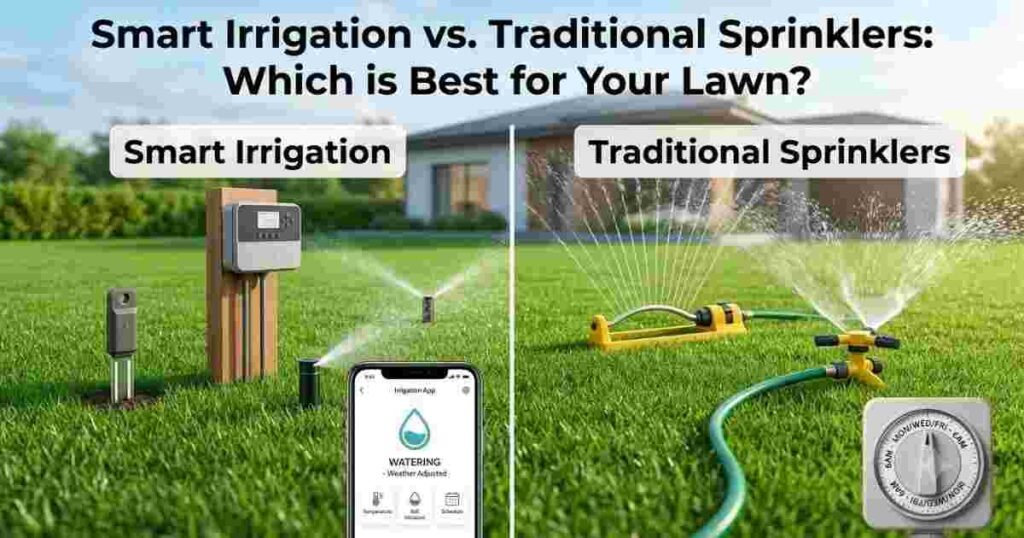
Properly managed lawns need sufficient water. Failure to provide enough water will dry out the lawn, while too much water might cause wastage of the same. To solve these problems, it is good to pick the right watering technique.
Thank you for reading this post, don't forget to subscribe!There are two common techniques: smart irrigation and traditional sprinklers. Let us analyze their features and pros and cons for each one of them.
What is Smart Irrigation?
Smart irrigation technology involves managing how frequently the sprinklers must operate, as well as the amount of water that must be provided to the lawn. Smart irrigation makes use of weather and soil condition information in making the decision to irrigate. This irrigation technology allows the regulation of settings via a mobile app.
What Are Traditional Sprinklers?
A traditional sprinkler system provides irrigation to your grass using stationary and rotating heads. The sprinklers could either work on a preset schedule or manually. They are easy to use and might work well for a small grass area. If you want something more permanent, the underground sprinkler system can be used. It can easily water several different spots on your lawn.
Comparison between Smart Irrigation System and Traditional Sprinklers
Both systems can effectively irrigate your lawn area. The main difference between the two lies in the working method of the two systems.
| Feature | Smart Irrigation | Traditional Sprinklers |
| Water control | Adjusts watering based on data or sensors | Often follows a fixed schedule |
| Water use | Can reduce waste | May waste water if poorly managed |
| Cost | Usually costs more | Often costs less |
| Ease of use | Offers automatic control | May need manual changes |
| Weather response | Some models respond to rain and heat | Basic models do not |
| Best for | Larger lawns and changing weather | Small lawns and simple needs |
This should make your choice easier. But there are a few other considerations as well.
- Water Usage and Conservation
A smart irrigation system may help conserve water by skipping irrigation after rains or adjusting timing based on the amount of moisture in the soil.
Standard sprinklers may consume excess water in case of forgetfulness about switching the sprinkler off or in case the timing isn’t changed during rains. Nonetheless, proper irrigation timing can help conserve water.
A smart irrigation system may prove handy if you are planning to save on water expenses. Your savings will depend on the size of the lawn and the weather.
2. Cost and Installation
Traditional sprinklers are usually cheaper to purchase and install. A simple model connected to the hose can be effective for a small lawn. Large models are more expensive, particularly those that require underground pipes. A smart irrigation system will most likely have a higher upfront cost. It may come with components such as sensors, smart controllers, and applications to control it. Some models require professional installation. Nonetheless, higher costs may eventually pay off in case of reduced water wastage. Evaluate initial costs against possible savings in the long run before making a decision.
3. Ease of Use
A smart irrigation system can come in handy if you have an active schedule. Once it is installed, it will take minimal efforts to keep track of watering. Some models allow changing settings using your phone. Installation and usage of the conventional sprinkler are very easy. Still, you should make adjustments based on weather conditions and the needs of the grass in terms of water supply. Consider an irrigation system suitable for you.
4. Health of the Grass and Coverage
With proper use, both technologies will result in healthy grass. Evenness and the right amount of watering are important.
Smart systems allow controlling the amount of water to match any changes in the situation. Thus, such a system might avoid any problems, like dry spots or overwatered grass. However, even with incorrect settings, a system can cause problems. A sprinkling system can also function efficiently, but you have to put sprinklers in the correct places and relocate them if necessary. Pay attention to your garden. Dry spots and wet grass will help you adjust the schedule.
Which Irrigation System Should Be Used?
It all comes down to your lawn and money. The intelligent irrigation system reduces water usage in accordance with weather changes. Normal sprinklers are easy and inexpensive. The target is clear: keep your lawn green and save water.
FAQs
1. Will smart irrigation fit into existing sprinklers?
Yes. There are smart controllers that are compatible with current automatic sprinkler systems. Caution: Test compatibility before purchasing a new controller.
2. What is the best time to water my lawn?
Early mornings may be the best time since there will be less water loss due to evaporation and winds, as well as allowing the grass to dry.
3. Do sprinkling systems need regular maintenance?
Yes, maintaining a sprinkling system needs unblocking sprinklers, detecting leaks, and ensuring that water reaches all parts of the grass.