
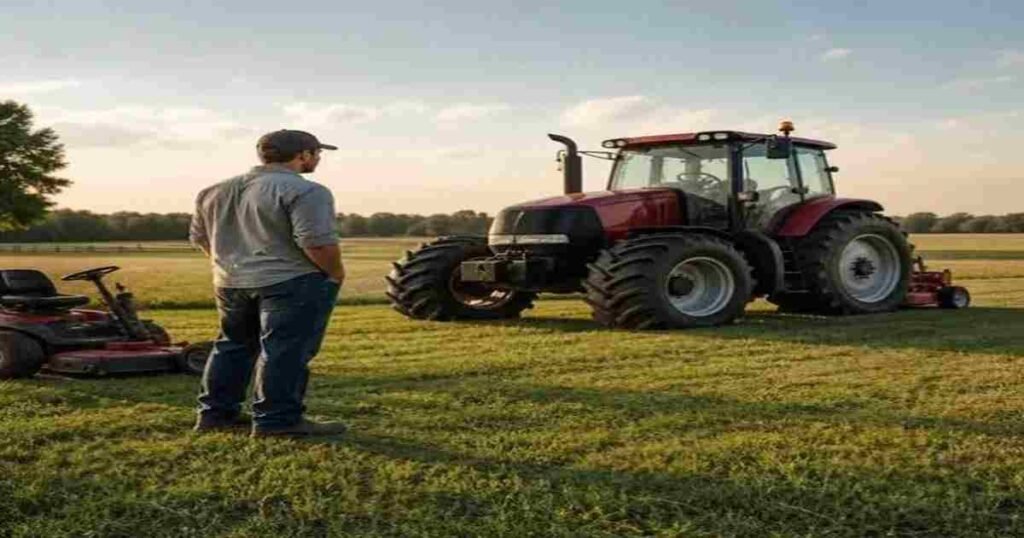
There is a point where a lawn tractor stops being the right tool. Maybe you bought five acres, and the brush at the back keeps winning. Maybe you need to move gravel, pull a box blade across a rutted drive, or lift round bales instead of grass clippings. That is the moment people start shopping for a compact or utility tractor—and it is also the moment a lot of money gets spent on the wrong machine, because horsepower is easy to compare and everything else is not.
Thank you for reading this post, don't forget to subscribe!This guide walks through how to size a tractor to the work you actually do, how to keep it running with sensible seasonal service, and why your relationship with a parts counter matters more than the badge on the hood.
Start with the implements, not the horsepower
A tractor is a power source and a hitch. Everything useful it does, it does through an implement, so the honest way to spec a machine is to list the implements you intend to run over the next five years, then buy the tractor that handles the heaviest of them comfortably.
A 5-foot rotary cutter, for example, generally wants a tractor in the 25- to 35-horsepower range at the PTO, not just at the engine — those two numbers are different, and the PTO figure is the one that mows. A 6-foot cutter or a tiller pushes you higher. Hay equipment is where people underestimate most: a small round baler asks for steady PTO power and enough rear weight to stop the machine from being shoved around on a slope.
Loader capacity deserves the same scrutiny. Manufacturers publish lift capacity at the pivot pins and at a set height, and those are not the same as what a pallet fork will carry at full extension. If you plan to handle bales, compare the rated capacity against the real weight of a wet 4×5 round bale, which can be considerably heavier than the dry figure you have in your head.
Compact versus utility: the practical dividing line
- Compact (roughly 20–45 hp): tight turning, easier on turf, fits through gates and under barn doors, excellent for mowing pasture, grading drives, light loader work and food plots.
- Utility (roughly 45–100 hp): heavier frame, higher hydraulic flow, more lift at the three-point hitch, better suited to tillage, hay, larger cutters and all-day fieldwork.
Weight matters as much as power. A light tractor with big numbers on the sticker will spin its tires and bounce; a heavier machine at the same horsepower will pull. If you are working hills, the lower center of gravity and wider stance of a utility chassis is a genuine safety feature, not a nicety.
The details buyers skip and later regret
Transmission choice drives daily satisfaction more than almost anything else. Hydrostatic transmissions are forgiving for loader work, where you change direction dozens of times an hour. Gear or shuttle transmissions give you better efficiency and more precise ground speed for mowing and tillage. If three-quarters of your hours will be on a loader, hydrostatic usually wins the argument.
Then there is the equipment that keeps you working in bad conditions: four-wheel drive, a differential lock, R4 industrial tires versus R1 ag lugs versus turf tires, a mid-mount PTO if you want a belly mower, and remote hydraulic outlets if a future implement needs a cylinder. Adding remotes later is possible but rarely cheap. The same goes for a cab—pleasant in January, but it changes the machine’s height and weight, so measure your barn door before you fall in love.
It helps to understand how little the basic architecture has changed and why. The history and engineering of the farm tractor explains how the power take-off, three-point hitch and drawbar became near-universal standards—which is exactly why a 40-year-old implement can still bolt onto a machine built this year, and why buying into those standards protects your investment.
A seasonal service rhythm that actually gets followed
Most tractor problems are maintenance problems wearing a disguise. Keep it simple and tie the work to the calendar rather than to hour meters you forget to read.
Spring, before the first real workload
- Change engine oil and filter; inspect fuel filters and drain the water separator.
- Check hydraulic fluid level and look for seepage at cylinder rods and hose fittings.
- Grease every zerk on the loader, three-point, and driveline—including the ones on the implement.
- Set tire pressures; mismatched fronts on a 4WD machine cause driveline wind-up.
- Test lights, flashers, and the slow-moving-vehicle sign if you travel any public road.
Mid-season, roughly every 50 hours
- Blow out the radiator screen and air filter—chaff and seed heads are the quiet killers.
- Check PTO shaft shields and shear bolts on cutters and balers.
- Inspect mower blades and gearbox oil; a dull blade burns fuel and tears grass.
Fall and winter layup
- Top off the fuel tank to limit condensation, and treat diesel if the machine will sit.
- Test coolant freeze protection and battery condition before the first hard frost.
- Wash off soil and manure, then grease again—corrosion does its worst work in storage.
If part of your acreage is managed lawn rather than pasture, the tractor’s calendar should line up with your turf calendar too. Core aeration and dethatching both want specific soil and growth conditions, and the difference between the two jobs is often misunderstood—reading up on whether your lawn needs dethatching or aerating will tell you which implement is worth hanging off the three-point hitch and which is a waste of a Saturday.
Parts, service and why the dealer is part of the purchase
A tractor is a ten- or twenty-year commitment, and the thing that determines whether those years are pleasant is how quickly you can get a filter, a hydraulic hose, or a baler belt during the week you need it. That is a parts-counter question, not a brochure question. When you are comparing machines, it is worth comparing dealers in the same breath: ask what they have in stock, how service scheduling works during the busy season, and whether they will take your existing implements into account when specing a new tractor. Dealerships like H&R Agri-Power, which serve Kentucky, Tennessee, Indiana, and surrounding states from multiple locations, handle all three sides of that equation—they list new Kubota tractors for sale alongside used equipment, supply genuine Kubota parts and replacement parts for tractors, mowers, and balers, and carry out repair work at their dealership locations, which means the people who sold you the machine are the people who see it again at its 400-hour service.
Genuine parts are worth the small premium in two places especially: filtration and hydraulics. A cheap filter with the wrong media or a missing bypass valve can cost you an engine or a pump, and a hose built to the wrong pressure rating fails at the worst possible moment. For wear items like blades, tines, and belts, aftermarket options are often fine—just match the specification rather than the picture.
Buying with your eyes open
If you are considering using, bring a flashlight and a plan. Look at the loader pins and bushings for slop, the tires for sidewall cracking, and the rear axle seals for weeping oil. Cold-start it yourself. Cycle the loader and three-point through full travel and listen for a pump whining under load. Ask for service records, and read the hour meter against the wear on the pedals and seat—a mismatch tells its own story.
Then take the demo seriously. Drive the machine on your own ground if you can, with the implement you will actually use, and pay attention to visibility over the loader, how far you have to reach for the range lever, and whether you can get on and off fifty times a day without hating it. Specs get you to a shortlist; an hour in the seat picks the winner.