 Skip to content
Many homeowners feel frustrated when their lawn looks thin, patchy, or brown even after regular watering, mowing, and fertilizing. I have seen this problem many times while helping neighbors and clients with their lawns. In most cases, the issue is not poor care or bad soil. The real problem is choosing the wrong grass type for the local climate, sunlight, or lawn use. When the grass does not match the environment, no amount of effort can make it perform well.
I once worked with a homeowner who spent a lot of money on lawn treatments, yet his lawn kept dying every summer. After checking his yard, we realized he had planted a cool-season grass in a hot southern climate. Once he switched to a warm-season grass, the lawn improved quickly and stayed green longer with less effort. That experience showed me how important it is to understand grass types before investing time and money into lawn care.
- You own a home with a lawn or yard.
- You want a healthy lawn with less effort.
- You are planning to seed, sod, or renovate your lawn.
- You want to avoid wasting money on the wrong grass.
- Grass types are divided into cool-season and warm-season groups.
- The best grass depends on climate, sunlight, and lawn use.
- Choosing the wrong grass leads to poor results even with good care.
- Matching grass to your region saves water, money, and effort.
- What Are Grass Types?
- Cool-Season and Warm-Season Grass Types
- Transition-Zone Grass Types
- Turfgrass Categories Based on Use
- Cultivars, Varieties, Blends, and Mixes
- Turfgrass Species for the Midwest
- Other Species Occasionally Used
- What Does Each Grass Type Look Like?
- Grass Type Characteristics
- Expert Insight: Rhizomatous Tall Fescue
- How to Identify What Grass You Have
- General Grass Care by Season
- Best Time to Plant Grass
- Grass Types by USDA Climate Zones
- Additional Turfgrass Species
- Blends, Mixes, and Overseeding
- Quick Grass Characteristics Comparison
- Popular Grass Comparisons
- Best Grass by Lawn Need
- Practical Advice for Choosing and Using Grass Types
- Common Mistakes When Choosing Grass
- Turfgrass Selection Summary
- FAQ About Grass Types
- What You Need to Know About Different Types of Grasses
- Conclusion
What Are Grass Types?
Grass types are different kinds of turfgrass used for lawns.
Each type grows best in certain weather and soil.
Some grasses grow better in cool weather.
Others grow better in hot weather.
That is why grass types are grouped by seasons.
Cool-Season and Warm-Season Grass Types
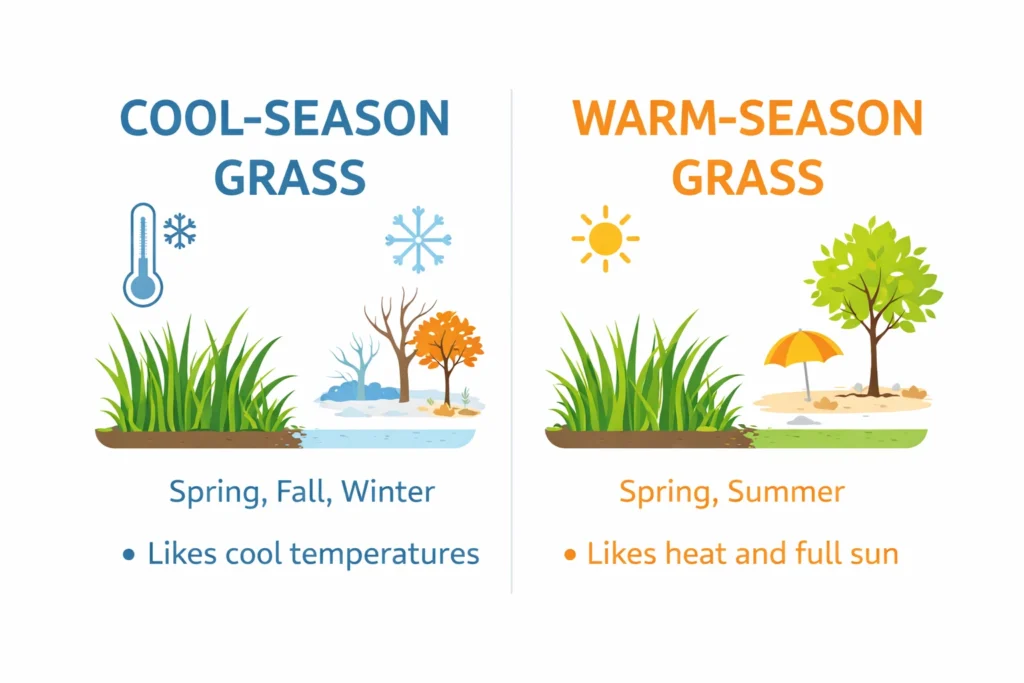
There are two main grass types based on temperature.
| Grass Type | Best Climate | Shade | Drought | Traffic | Maintenance |
|---|---|---|---|---|---|
| Tall Fescue | Cool / Transition | Medium | High | Medium | Low |
| Kentucky Bluegrass | Cool | Low | Low | Medium | Medium |
| Fine Fescue | Cool | High | Medium | Low | Low |
| Bermudagrass | Warm | Low | High | High | Medium |
| Zoysia | Warm / Transition | Medium | Medium | Medium | Low |
| St. Augustine | Warm | High | Low | Medium | Medium |
Cool-Season Grass Types
Cool-season grasses grow best in spring and fall.
They like mild temperatures and cooler air.
Common cool-season grass types:
- Kentucky Bluegrass
- Tall Fescue
- Fine Fescue
- Perennial Ryegrass
- Bentgrass
These grasses are common in northern states.
They grow fast in cool weather.
However, they can struggle in strong summer heat.
If you are trying to decide between these popular cool-season grasses, see our detailed comparison of Kentucky Bluegrass vs Fescue vs Ryegrass to understand differences in growth, shade tolerance, maintenance, and lawn use.
Warm-Season Grass Types
Warm-season grasses grow best in late spring and summer.
They love heat and sunlight.
Common warm-season grass types:
- Bermudagrass
- Zoysiagrass
- St. Augustinegrass
- Centipedegrass
- Bahiagrass
- Buffalograss
These grasses are common in southern states.
They handle heat well.
However, they turn brown in cold winters.
If you are unsure whether your lawn is Bermuda grass, our What Does Bermuda Grass Look Like guide shows clear visual signs such as blade shape, runners, seed heads, and winter color.
Transition-Zone Grass Types
Some areas are not fully hot or fully cold.
These areas are called transition zones.
In these areas, both grass types can struggle.
That is why people use special blends.
Common transition grasses:
- Tall Fescue
- Zoysia
- Hybrid Bermudagrass
- Kentucky Bluegrass blends
These grasses are chosen for flexibility.
Selecting grass for the transition zone requires extra care. To compare characteristics, maintenance needs, and performance across climates, explore our guide on types of lawn grasses used in the USA.
Turfgrass Categories Based on Use
Grass types are also chosen based on use.
Lawn Turf
Used for home lawns and gardens.
Focus is on beauty and comfort.
Some homeowners choose grass mainly for appearance, layout, and landscape design rather than traffic or speed. If your goal is curb appeal or yard styling, see our Types of Grass for Landscaping guide.
Sports Turf
Used for sports fields and parks.
Focus is on strength and fast recovery.
Utility Turf
Used for roadsides and large open areas.
Focus is on low care and survival.
Cultivars, Varieties, Blends, and Mixes
A cultivar is a special type of grass bred for better results.
It may grow thicker or resist disease better.
A blend is a mix of the same grass species.
A mix is a mix of different grass species.
Blends and mixes improve lawn strength and survival.
Turfgrass Species for the Midwest
Common Midwest grasses include:
- Kentucky Bluegrass
- Tall Fescue
- Perennial Ryegrass
- Zoysiagrass
- Buffalograss
These grasses handle both cold winters and warm summers.
Other Species Occasionally Used
Some grass types are less common but still useful.
These include:
- Carpetgrass
- Kikuyugrass
- Creeping Bentgrass
They are used for special soil or climate needs.
What Does Each Grass Type Look Like?
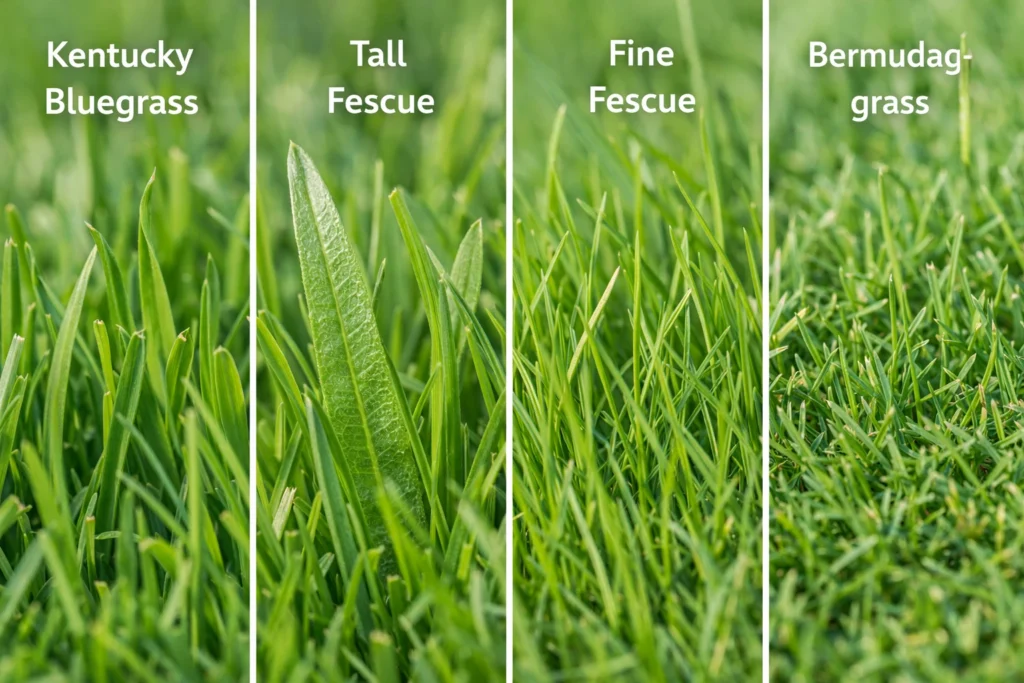
Here is a simple way to recognize common grasses:
- Kentucky Bluegrass: Soft, fine to medium blades with a smooth texture and blue-green color. The leaf tip is rounded like a small boat, and the grass spreads underground. For close-up identification help, see What Does Kentucky Bluegrass Look Like.
- Tall Fescue: Wider blades, deep green, grows in clumps
- Fine Fescue: Very thin, soft blades, light green color
- Bermudagrass: Fine blades, dense growth, bright green
- Zoysia: Thick carpet feel, medium green, slow growing
- St. Augustine grass: Very wide, flat blades with rounded tips and a coarse feel. The lawn spreads sideways using thick runners above the soil. For step-by-step confirmation in real lawns, see St Augustine Grass Identification.
This helps you visually match your lawn to a grass type.
Grass Type Characteristics
Each grass type has unique traits.
Key traits include:
- Shade tolerance
- Drought tolerance
- Traffic tolerance
- Growth speed
- Water needs
For example:
Tall Fescue has deep roots and handles drought well. For a complete comparison of tall fescue and other fescue types, see Tall Fescue vs Fescue. Kentucky Bluegrass spreads fast and repairs itself.
Expert Insight: Rhizomatous Tall Fescue
Rhizomatous tall fescue spreads slowly through underground stems called rhizomes. This gives it better self-repair than traditional tall fescue and makes it a strong choice for high-traffic family lawns in transition zones.
Short on time?
Cool climates: Tall Fescue or Kentucky Bluegrass
Hot climates: Bermuda or Zoysia
Shady lawns: Fine Fescue or St. Augustine
- If you live in a hot climate → Choose a warm-season grass.
- If you live in a cold climate → Choose a cool-season grass.
- If your lawn has shade → Choose Fine Fescue or St. Augustine.
- If your lawn has kids or pets → Choose Bermudagrass or Tall Fescue.
- If you want low care → Choose Zoysia or Tall Fescue.
How to Identify What Grass You Have
If you already have a lawn, it helps to know what grass you are working with.
You can identify your grass by checking:
- Blade width (thin or wide)
- Color (light green, dark green, blue-green)
- Growth habit (spreading or clumping)
- Season when it grows fastest
You can also take a clear photo and compare it with online grass guides or learn how to identify your lawn grass step by step in our detailed guide, or ask a local garden center or extension office for help.
| Check | What to Look For |
|---|---|
| Blade width | Thin = Fine grasses, Wide = Coarse grasses |
| Color | Blue-green = Kentucky Bluegrass, Bright green = Bermuda |
| Growth habit | Spreading = Rhizomes/Stolons, Clumping = Bunch grasses |
| Season growth | Spring/Fall = Cool-season, Summer = Warm-season |
General Grass Care by Season
Spring
Rake dead grass.
Apply fertilizer.
Repair bare spots.
Summer
Water deeply but less often.
Mow higher to protect roots.
Fall
Aerate the soil.
Overseed cool-season grasses.
Apply fall fertilizer.
Winter
Limit foot traffic.
Remove heavy debris.
Best Time to Plant Grass
Planting at the right time helps grass grow faster and stronger.
Soil temperature is more important than calendar dates, especially when planting grass seed.
- Cool-season grasses grow best when planted in early fall or early spring.
- Warm-season grasses grow best when planted in late spring or early summer.
Avoid planting during extreme heat or frost.
Grass Types by USDA Climate Zones
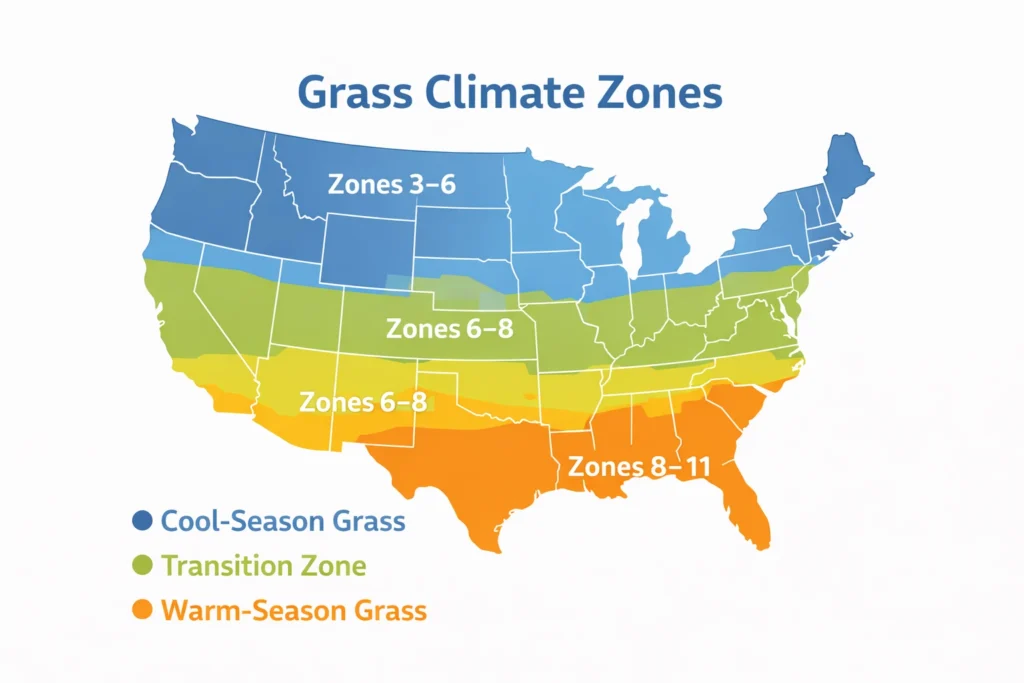
- Zones 3–6:
Kentucky bluegrass, tall fescue, fine fescue - Zones 6–8:
Tall fescue, zoysia, hybrid bermuda - Zones 8–11:
Bermuda, zoysia, St. Augustine, centipede
| Region | Best Grasses |
|---|---|
| Northeast | Kentucky Bluegrass, Tall Fescue |
| Midwest | Tall Fescue, Bluegrass, Ryegrass |
| Southeast | Bermuda, St. Augustine, Centipede |
| Southwest | Bermuda, Buffalograss |
| Pacific Northwest | Fine Fescue, Ryegrass |
| California | Tall Fescue (north), Bermuda (south) |
Additional Turfgrass Species
- Creeping Bentgrass
- Annual Bluegrass
- Rough Bluegrass
- Seashore Paspalum
Blends, Mixes, and Overseeding
Overseeding helps fill thin areas and improve lawn health.
It is done in fall for cool-season lawns and spring for warm-season lawns.
Quick Grass Characteristics Comparison
Tall Fescue: drought tolerant, medium shade
Kentucky Bluegrass: self-repairing, needs water
Fine Fescue: shade tolerant, low traffic
Bermuda: heat tolerant, high traffic
Zoysia: slow growing, heat tolerant
St. Augustine: shade tolerant, needs water
Popular Grass Comparisons
You may want deeper comparisons between similar grasses.
You can explore:
- Tall Fescue vs Kentucky Bluegrass
- Bermudagrass vs Zoysia
- Fine Fescue vs Tall Fescue
- St. Augustine vs Bermuda
These comparisons help you choose between grasses that seem similar but behave differently.
Zoysia Grass vs Fescue – A side-by-side look at warm-season vs cool-season lawns based on sun, shade, climate, and care.
| Comparison | Best For |
|---|---|
| Tall Fescue vs Kentucky Bluegrass | Cold vs transition climates |
| Bermudagrass vs Zoysia | Fast growth vs low maintenance |
| Fine Fescue vs Tall Fescue | Shade vs durability |
| St. Augustine vs Bermuda | Shade vs traffic tolerance |
Best Grass by Lawn Need

- For kids and pets: Bermudagrass, Tall Fescue
- For shade: Fine Fescue, St. Augustine
- For drought: Bermuda, Buffalograss
- For low maintenance: Zoysia, Tall Fescue
If you want fast green color or need to overseed a lawn quickly, a ryegrass lawn is often used. Our Ryegrass Lawn guide explains when it works well and when it causes problems.
Practical Advice for Choosing and Using Grass Types
Before buying seed or sod, check how much sun your lawn gets, how often it is used, and how the soil drains. Many lawn problems happen because grass is planted without considering these basics.
Always match grass to your climate and planting season. Cool-season grasses perform best in cooler months, while warm-season grasses need warm soil to establish. Choose quality seed or healthy sod instead of the cheapest option, and if you are unsure, start with a small test area before planting the entire lawn.
Common Mistakes When Choosing Grass
- Picking grass for looks, not climate
- Ignoring shade and traffic
- Planting at the wrong time
- Using the wrong seed type
Another common mistake is treating annual bluegrass like permanent turf. This usually shows up as light green color and early white seedheads in spring. If this sounds familiar, our Annual Bluegrass vs Kentucky Bluegrass guide explains how to identify the problem and choose the right approach.
Turfgrass Selection Summary
Choose based on climate, sunlight, water, and use.
FAQ About Grass Types
What is the easiest grass?
Tall Fescue and Zoysia.
Best grass for shade?
Fine Fescue and St. Augustine.
Best grass for drought?
Bermuda and Buffalograss.
What You Need to Know About Different Types of Grasses
Each grass has strengths and limits.
The right match makes lawn care easier.
If you want help choosing the best grass for your location, check your USDA zone or talk to a local lawn professional before planting.
Conclusion
From years of working with different lawns, I have learned that the right grass choice makes lawn care easier, cheaper, and far less stressful. When the grass matches the climate, sunlight, and foot traffic of a yard, it naturally grows stronger and resists problems like drought, weeds, and disease. Most lawn failures are not caused by neglect, but by starting with the wrong grass. By choosing a grass type that fits your conditions, you create a healthier lawn that needs less water, fewer chemicals, and less constant attention. This simple decision saves money, protects your time, and gives you a lawn you can actually enjoy.