
- How Your Landscaping Affects Your Home
- Mistake 1: Grading That Slopes Toward the House
- Mistake 2: Overloaded Planting Beds Against the Foundation
- Mistake 3: Skipping or Undersizing a Drainage System
- Mistake 4: Downspouts That Discharge Too Close to the House
- Mistake 5: Hardscaping Installed Without a Drainage Plan
- Mistake 6: Tree and Shrub Placement Too Close to the Foundation
- When Landscaping Fixes Aren't Enough
- Getting the Basics Right
- How Your Landscaping Affects Your Home
- Mistake 1: Grading That Slopes Toward the House
- Mistake 2: Overloaded Planting Beds Against the Foundation
- Mistake 3: Skipping or Undersizing a Drainage System
- Mistake 4: Downspouts That Discharge Too Close to the House
- Mistake 5: Hardscaping Installed Without a Drainage Plan
- Mistake 6: Tree and Shrub Placement Too Close to the Foundation
- When Landscaping Fixes Aren't Enough
- Getting the Basics Right
How Your Landscaping Affects Your Home
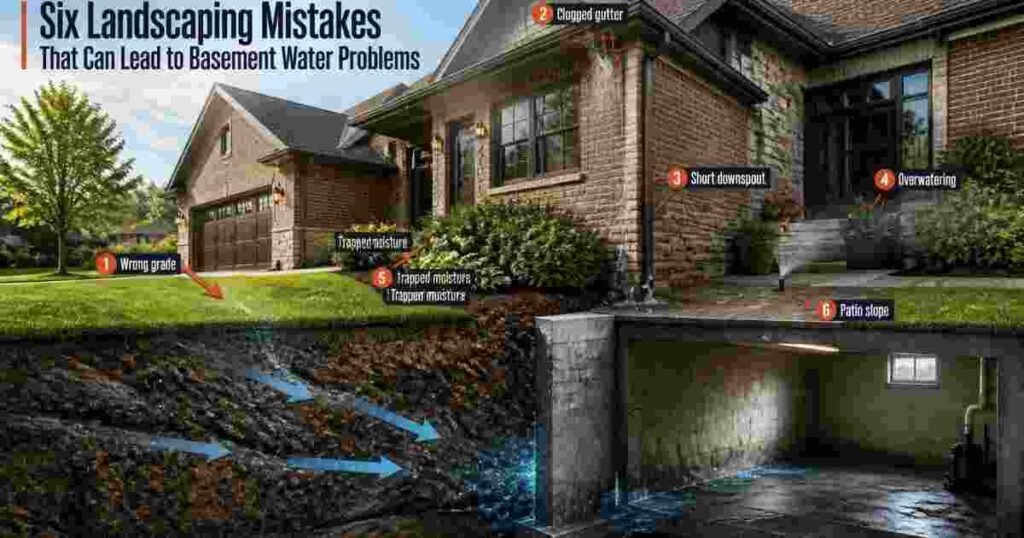
Most homeowners think about landscaping purely in terms of curb appeal: a tidy lawn, full flower beds, maybe a new paver patio. What rarely comes up in those conversations is that the yard also acts as the first line of defense against water reaching the basement. Grading, plant placement, mulch depth, and drainage decisions made outside the house directly determine how much water pressure builds up against the foundation walls below.
Thank you for reading this post, don't forget to subscribe!Get the landscaping wrong, and the yard starts working against the house rather than protecting it, creating the exact conditions for a wet basement. Most of these mistakes stay invisible for years, so a yard can look perfectly maintained while quietly funneling water toward the foundation every time it rains. Once a foundation has absorbed enough water, landscaping alone can’t solve the problem, and homeowners must consider basement waterproofing to address moisture that has already reached the inside.
Mistake 1: Grading That Slopes Toward the House
The most common and most damaging mistake is grading that tilts toward the foundation. Even a slight negative grade, where the soil dips down as it nears the house, funnels every rainstorm directly at the walls. On a properly graded lot, that same rainfall would spread across the yard and soak in gradually. Over months and years, misdirected water works its way through hairline cracks and porous block joints.
Correcting the grade is the first line of defense, since it stops feeding the problem. It works best as prevention, not a cure for water that has already found its way through the wall. Checking the grade doubles as one of the simplest DIY diagnostics: after a heavy rain, walk the perimeter of the house and note any spot where water pools or sheets toward the foundation. Those low points are where regrading should start.
Mistake 2: Overloaded Planting Beds Against the Foundation
A second mistake is packing planting beds directly against the foundation and layering them with thick mulch. Beds that hug the house hold moisture right where you don’t want it, and mulch, while excellent for retaining water for plants, does the same thing against a foundation wall. The soil underneath stays damp long after the surrounding yard dries out.
Combine dense foundation beds with clay-heavy soil, and the result is a cycle of expansion and contraction that stresses the foundation in ways that aren’t always visible right away. Heat and drought pull moisture out of the clay and cause it to shrink. Heavy rain then lets the clay swell back up, and the repeated movement can gradually work cracks open in the foundation over a few years. It’s a slower-moving problem than a burst pipe, but seasonal swings in soil moisture are worth watching just as closely.
Mistake 3: Skipping or Undersizing a Drainage System
Many yards skip a real drainage system altogether and rely on grading alone to move water away from the house. That approach works fine on a small, evenly sloped lot, but most properties have low spots and clay pockets where water simply has nowhere else to go. Shaded areas add another wrinkle, since the soil there rarely gets a chance to dry out between storms. A French drain or a buried downspout extension routed to daylight can carry water well away from the house before it ever has the chance to saturate the soil beside the foundation. A dry well works too, particularly where the yard has room to spare.
As a general benchmark, the ground around a home should slope away from the foundation at a minimum of one-quarter inch per foot for the first few feet. Any area that can’t achieve that slope naturally is a candidate for a dedicated drainage solution instead of more regrading. French drains in particular need occasional maintenance to keep working. Sediment and root growth can clog the perforated pipe within a few years, which is why an annual flush-out with a garden hose belongs on a spring maintenance checklist alongside gutter cleaning.
Mistake 4: Downspouts That Discharge Too Close to the House
Downspouts get their own mention because getting them wrong is easy to do and easy to ignore. A downspout that empties two feet from the foundation, or worse, directly into a mulch bed against the house, concentrates a large volume of roof runoff exactly where it shouldn’t be. During a heavy storm, that’s a lot of water landing in a small footprint right next to the wall.
Extensions should carry water at least four to six feet away from the structure, and further on sloped or clay-heavy lots. That distance aligns with baseline building science guidance on foundation drainage, which generally recommends keeping roof water from saturating the soil right at the foundation line.
Flexible corrugated extensions are the most common downspout accessory sold at hardware stores, yet they collapse and clog easily, plus they tend to get kicked out of place by mowers or foot traffic. A rigid extension or a buried solid pipe running to an above-grade pop-up emitter holds up far better over time and doesn’t need to be reset every season.
Mistake 5: Hardscaping Installed Without a Drainage Plan
Hardscaping is another common blind spot. A patio or walkway installed without a slope plan can act like a ramp, funneling rainwater straight toward the house rather than spreading it across the yard the way bare soil or lawn would. Driveways cause the same problem on a larger scale, since a wide impervious surface sheds far more water than the ground it replaced. A hardscape project that ignores drainage speeds up the exact problem most homeowners are trying to landscape their way out of in the first place.
Anyone planning new hardscaping this season should consider the layout before finalizing anything, since drainage decisions are much cheaper to build in from the start than to retrofit later. A patio that looks great but pitches the wrong way is an expensive mistake to undo once the pavers are set.
Mistake 6: Tree and Shrub Placement Too Close to the Foundation
Tree and shrub placement is easy to overlook, but it matters more than most homeowners realize. Large trees planted too close to the foundation draw moisture unevenly from the surrounding soil, and that can worsen the same expansion and contraction cycles caused by dense clay. Root systems also grow into buried drain lines and footing tile over time. The damage undoes drainage work that was otherwise installed correctly.
A reasonable rule of thumb is to keep large, mature trees at a distance roughly equal to their expected mature height, and to reserve smaller ornamental species or shrubs for any planting closer to the house. Since trees take years to establish, this is a slower fix than regrading or extending a downspout, but it prevents a problem that gets more expensive to correct the longer it’s ignored. If a mature tree is already established too close to the foundation, removal isn’t always the right call. Root barriers installed between the tree and the house can redirect growth away from drain lines and footings without sacrificing an otherwise healthy tree.
When Landscaping Fixes Aren’t Enough
None of these landscaping corrections work in isolation, and none of them replace addressing water that’s already gotten into the basement. Grading and drainage systems reduce the water pressure building up outside the foundation walls, and smart plant placement helps too, but together they still can’t undo years of accumulated moisture damage or seal cracks that have already formed. That’s when exterior fixes alone aren’t enough, and the problem needs attention from inside the structure as well.
Getting the Basics Right
The good news is that most of these mistakes are fixable without a full landscape overhaul, and none of them require specialized equipment or a big weekend project to start correcting. Start with the grade closest to the house, since it has the biggest impact with the least work. From there, move mulch and dense plantings back from the foundation and make sure downspouts are actually extending water where it needs to go. Any new hardscaping should be designed with slope in mind from day one, not adjusted after the fact.
Choosing a local landscaper can also be helpful when you need to fix drainage issues around your home. For example, Shoreline is a city in Washington, just north of Seattle, known for its parks and green spaces. If you need help with landscaping in Shoreline, WA, a local professional can assess your yard and help you make changes that direct water away from your home’s foundation.
Landscaping alone won’t guarantee a dry basement, but getting these basics right removes most of the preventable causes of water intrusion in the first place. It also makes any additional exterior or interior waterproofing work far more effective, since it isn’t fighting a constant, avoidable source of water at the same time. A once-a-year walkthrough after a heavy storm catches most of these issues while they’re still cheap to fix. Check the grade first, then the downspouts, then the beds closest to the house, well before any of it turns into a basement problem.