
- Why Soil Stability Matters to Your Foundation
- Understanding the Different Ways Soil Moves
- How Expansive Soil Pushes and Pulls on Foundations
- Settlement: When Soil Loses Its Ability to Support the Structure
- The Role of Water in Foundation-Related Soil Movement
- How Landscaping Can Influence Soil Conditions Around a Home
- Warning Signs That Soil Movement May Be Affecting the Foundation
- How to Reduce the Risk of Soil-Related Foundation Problems
- When to Have Foundation Movement Professionally Evaluated
- Conclusion: Protect the Soil to Protect the Foundation
- Why Soil Stability Matters to Your Foundation
- Understanding the Different Ways Soil Moves
- How Expansive Soil Pushes and Pulls on Foundations
- Settlement: When Soil Loses Its Ability to Support the Structure
- The Role of Water in Foundation-Related Soil Movement
- How Landscaping Can Influence Soil Conditions Around a Home
- Warning Signs That Soil Movement May Be Affecting the Foundation
- How to Reduce the Risk of Soil-Related Foundation Problems
- When to Have Foundation Movement Professionally Evaluated
- Conclusion: Protect the Soil to Protect the Foundation
Why Soil Stability Matters to Your Foundation
A home’s foundation doesn’t exist independently of the property around it. It transfers the structure’s weight into the soil, so the ground beneath and beside the building directly affects how well the foundation performs over time. When the soil remains reasonably stable, loads are distributed as intended. When it expands, contracts, settles, erodes, or shifts unevenly, the foundation may experience stress that gradually appears as cracks, gaps, or changes in how rooms and openings function.
Thank you for reading this post, don't forget to subscribe!That makes soil stability more than a construction concern. It’s also a landscape and property-management issue. Roof runoff, irrigation, planting beds, grading, and excavation can all change the moisture and support conditions near a home. When recurring signs of movement appear, foundation repair contractors can assess the condition and recommend the right next step.
Homeowners who understand these connections can use practical drainage basics to reduce avoidable stress on the soil supporting the structure.
Understanding the Different Ways Soil Moves
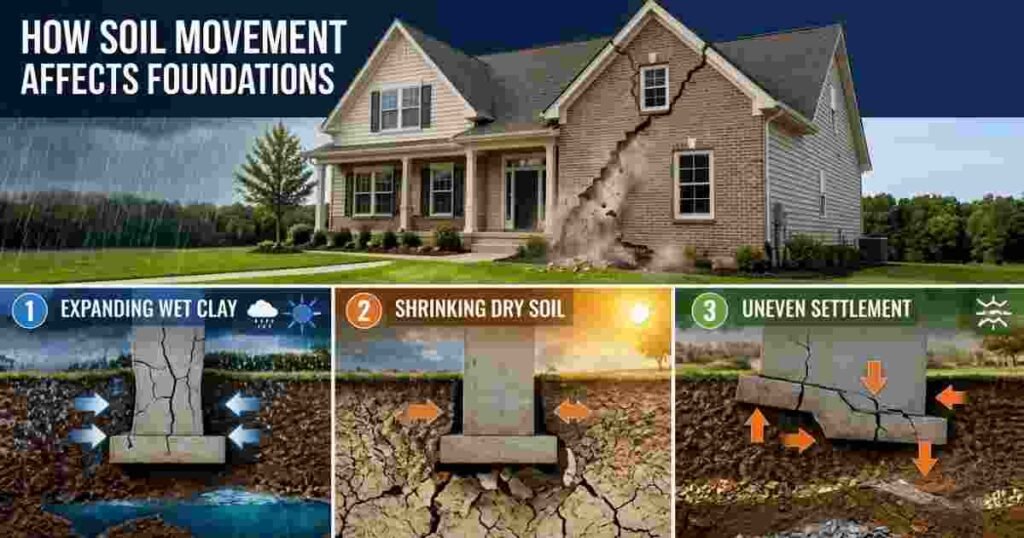
Soil movement can take several forms, and each one affects a foundation differently. Settlement occurs when soil compresses or shifts downward under a load. Expansion and contraction occur when moisture-sensitive soils swell when wet and shrink during dry periods. Erosion removes or carries away supporting particles, often where water is concentrated. Lateral movement pushes soil sideways, which can place pressure against foundation walls or move sloped ground downhill.
Not every movement event creates a serious problem. A structure may tolerate a small amount of uniform movement because the entire foundation changes position together. Differential movement is more concerning because one part of the foundation may move more than another or shift in a different direction. That uneven change can distort walls, floors, frames, and connections. Soil composition is central to the risk. Clay-rich soils often respond strongly to moisture, while loose fill or compressible soils may settle under load. Moisture patterns, surface grading, vegetation, drainage routes, and the history of site disturbance also determine where movement is likely.
How Expansive Soil Pushes and Pulls on Foundations
Expansive soil contains minerals, commonly associated with clay, that change volume as they absorb and release water. After heavy rain or prolonged irrigation, the soil may swell and exert upward or sideways pressure on footings, slabs, and foundation walls. During a dry spell, the same soil can shrink, leaving voids or reducing support beneath portions of the structure. This is a recurring cycle rather than a one-time event, and it can repeatedly stress building materials.
The pattern matters as much as the amount of movement. If moisture reaches one side of a home while another side remains relatively dry, the foundation may respond unevenly. Repeated wet-dry cycles can contribute to diagonal or stair-step cracking in masonry, separations in concrete, and cracks in interior finishes. Doors and windows may become harder to operate because frames shift slightly out of square. These signs don’t automatically prove that expansive soil is the cause, but their timing, location, and relationship to drainage or irrigation can provide useful clues during an evaluation.
Settlement: When Soil Loses Its Ability to Support the Structure
Settlement develops when the soil beneath a foundation compresses, rearranges, or loses material. Loose fill, poorly compacted soil, organic material, and naturally compressible layers can all provide less reliable support than dense, undisturbed ground. Newly placed fill may appear firm at the surface while continuing to consolidate below. Moisture changes can also soften certain soils, wash particles away, or alter the pressure that holds grains together.
Uniform settlement may produce limited visible distress because the structure moves as a whole. Differential settlement is more likely to create problems because separate sections of the foundation respond differently. One corner may drop while another remains stable, or an addition may settle at a different rate from the original structure. This can produce sloping floors, gaps around frames, wall cracks, and misaligned roof or ceiling connections. Erosion, leaking plumbing, altered drainage, and excavation near the structure may intensify the problem. The appropriate response depends on whether the soil is still consolidating, whether water is removing support, and whether the foundation itself has been damaged.
The Role of Water in Foundation-Related Soil Movement
Water is one of the most influential factors affecting soil conditions around a home. Excess moisture can weaken supporting soil, increase settlement, trigger expansion in clay-rich ground, and carry soil away through erosion. It can enter the system through ordinary sources such as roof runoff, downspouts, sprinkler overspray, leaking irrigation lines, clogged drains, and low areas that collect stormwater. A small change in where water concentrates may produce a large change in the moisture content of nearby soil.
For that reason, controlled drainage is essential to protecting the ground that supports a foundation. Surface grades should generally encourage water to move away from the structure rather than pool beside it. Downspouts need a safe discharge point, and drainage channels should remain open and functional. Irrigation should wet plants efficiently without repeatedly saturating the foundation zone. FEMA guidance identifies poor site drainage as a condition that can weaken supporting soil, reinforcing the importance of treating water management as part of property maintenance rather than as an afterthought.
How Landscaping Can Influence Soil Conditions Around a Home
Landscaping can either support stable soil conditions or unintentionally create new movement patterns. Planting beds may change the height and slope of finished soil. Irrigation zones can deliver very different amounts of water to opposite sides of a house. Hardscapes may redirect runoff, while edging, retaining features, or added soil can block an established drainage path. Excavation for trees, patios, utility lines, or garden structures may disturb soil that had previously provided consistent support.
Compaction is another important consideration. Heavy equipment, repeated foot traffic, or construction activity can reduce pore space in soil, limiting infiltration and changing how water moves across the surface. Water may run off faster from compacted ground, collect in unexpected places, or bypass areas that previously absorbed it. Landscape planning should therefore account for existing slopes, drainage paths, soil characteristics, and erosion-prone areas. The goal is to manage these changes without directing concentrated runoff toward the foundation or creating sharp swings between saturated and very dry conditions.
Homeowners planning lawn or landscape changes can better understand soil structure and moisture management by learning what compact soil means and how it can affect their yard. Understanding how soil and moisture interact can help maintain a healthy landscape without unintentionally affecting the foundation’s moisture environment.
Warning Signs That Soil Movement May Be Affecting the Foundation
Visible changes deserve attention when they recur, worsen, or are connected to drainage and grading issues. Stair-step cracks in brick or block masonry, diagonal cracks extending from corners of doors and windows, and displacement in foundation walls can indicate that different parts of a structure are moving. Inside the home, sticking doors or windows, sloping floors, gaps around frames, and separation between walls and ceilings may reflect changes in alignment. These signs are more informative when tracked over time than when viewed in isolation.
Not every crack indicates structural failure. Small, stable cracks in paint, drywall, or a single finish layer may be cosmetic and may result from normal material shrinkage. Concern rises when a crack widens, reappears after repair, follows a consistent diagonal or stair-step pattern, or appears alongside floor changes and water problems. Homeowners can photograph signs with a date, note which doors or windows change, and record periods of heavy rain, drought, or irrigation adjustments. This information can help a professional distinguish a surface issue from a broader pattern of movement.
How to Reduce the Risk of Soil-Related Foundation Problems
Risk reduction begins with consistent moisture management. Maintain positive grading so water doesn’t sit against the foundation, and inspect downspouts to ensure they discharge far enough away to avoid creating a concentrated wet zone. Keep gutters, swales, catch basins, and other drainage routes clear. Adjust irrigation schedules during rainy or dry periods, repair leaks promptly, and avoid placing sprinklers so they repeatedly spray foundation walls or narrow strips of soil beside the house.
Landscape decisions should be made with the whole site in mind. Before adding soil, paving, large planting beds, or retaining features, consider whether the change will block a drainage path or redirect water. Avoid unnecessary excavation close to the structure, and be cautious about removing soil that helps resist erosion on a slope. In moisture-sensitive ground, consistency helps more than alternating between severe saturation and prolonged drying. Preventive maintenance can’t guarantee that a foundation will never move, but it can reduce the environmental conditions that make differential movement more likely.
When to Have Foundation Movement Professionally Evaluated
A professional evaluation makes sense when cracks recur or grow, settlement can be measured, a wall appears displaced, or floors, doors, and windows change noticeably over time. An evaluation is also wise when a drainage failure, erosion event, plumbing leak, or major grading project coincides with new symptoms. Early assessment can clarify whether the primary issue is soil movement, water management, material aging, or a combination of conditions. It may also prevent a homeowner from spending money on a repair that addresses a visible symptom while leaving the cause in place.
In these situations, qualified professionals can evaluate suspected foundation movement and determine whether repair or stabilization is appropriate. The correct solution depends on the cause and extent of the movement. Expansive soil, settlement, drainage-related weakening, and erosion shouldn’t automatically be treated with the same method. A careful assessment may include reviewing the site grade, observing crack patterns, checking elevations, examining drainage, and considering soil history before recommending a repair plan.
Conclusion: Protect the Soil to Protect the Foundation
A foundation depends on soil that remains stable, adequately supported, and reasonably consistent in moisture. Soil type, grading, drainage, landscaping, and weather all influence whether movement remains uniform or becomes differential enough to stress the structure. Clay-rich soils may swell and shrink. Loose or disturbed ground may settle. Concentrated water may soften or erode support. These processes often interact rather than occur in isolation.
The practical lesson is straightforward: protect the soil and you help protect the foundation. Direct water away from the structure, preserve effective drainage, manage irrigation carefully, and think through landscaping changes before they alter established runoff paths. Watch for recurring cracks, shifting openings, and floor changes, especially after unusual weather or site work. Noticing changes early and correcting water or grading problems can help prevent minor soil concerns from becoming more serious foundation issues.