
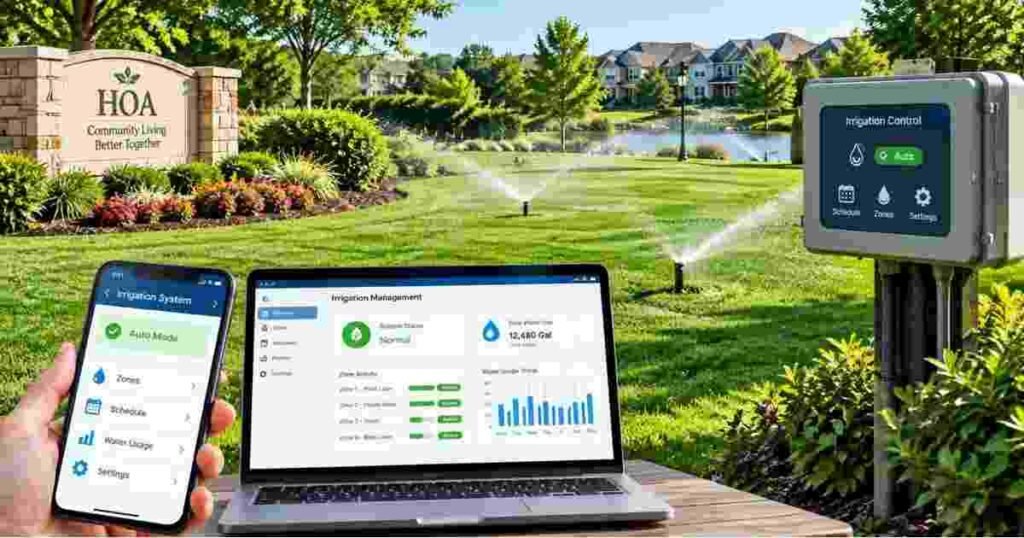
Walk past the clubhouse lawn at 2 p.m. in July, and you’ll sometimes see it: sprinklers running in full sun, water sheeting off the turf and into the gutter. Nobody in the HOA asked for that. The clock timer was set in April, and nobody touched it again.
Thank you for reading this post, don't forget to subscribe!That’s the core problem with big shared lawns. They’re too large to water by feel, and the people paying the bill rarely see the system run. This guide walks through how larger properties (HOAs, condo complexes, townhome communities, and office parks) take the guesswork out of watering. It covers the gear, the setup, and the questions a board should ask before signing a contract.
You don’t need to be an irrigation tech to follow along. You just need to know what to look for.
- Why Big Lawns Waste So Much Water
- The Smart Controller and What Plugs Into It
- Zones: Sun, Shade, Slopes, and Grass Type
- Flow Sensors Catch What Nobody Sees
- Working Around Local Watering Rules
- The Controller Is Only as Smart as Its Setup
- Budget and Payback, Without the Sales Pitch
- The Bottom Line
Why Big Lawns Waste So Much Water
A single-family yard might have six or eight zones. A mid-size HOA can have well over a hundred spread across several controllers. Each zone has its own heads, its own soil, and its own exposure to sun and wind.
When one person sets all of those on a fixed schedule, waste is almost built in. The EPA’s WaterSense program estimates that as much as 50 percent of the water used on large landscapes is wasted through overwatering caused by poor irrigation methods and systems.
Some of that waste is easy to spot, like spray hitting a sidewalk. Most of it isn’t. Water soaks past the root zone, runs off a slope at night, or keeps flowing through a cracked pipe under a parking strip. On a big property, nobody is out there at 4 a.m. to notice.
That’s why large sites lean on automation. The goal isn’t fancy tech for its own sake. It’s having something that watches the system when people can’t.
The Smart Controller and What Plugs Into It
The heart of an automated system is the controller. On older properties, it’s a gray box on a wall that runs the same minutes every day until someone changes it. A smart controller works differently.
Weather-based controllers adjust watering using evapotranspiration, or ET. That’s the amount of water the lawn loses to heat, sun, and wind each day. On a hot, windy day, the controller adds time. After a cool, rainy stretch, it cuts back or skips a cycle.
Many systems pull ET from a local weather station or an online weather feed. Some properties also add soil moisture sensors buried in the root zone. If the soil is still wet, the zone doesn’t run, no matter what the schedule says.
On bigger sites, these controllers are often “central” or cloud-based. Instead of walking to twelve boxes around the property, a manager or contractor can see and change every controller from one screen. That alone saves hours each season.
Larger properties sometimes take it one step further. Office parks, campuses, and big condo buildings may already run a building management system (BMS) for heating, cooling, and lighting. Irrigation controllers, flow meters, and leak alerts can feed into that same system, so one dashboard shows the chiller, the parking lot lights, and the sprinkler mainline side by side. For a sense of what these platforms can track, see these building management system features best insights by Glorium Technologies, which cover monitoring, alerts, and reporting across building systems.
Most HOAs don’t need that level of tie-in. But if your community already has a BMS for its clubhouse or towers, it’s worth asking whether irrigation data can live there too.
Zones: Sun, Shade, Slopes and Grass Type
A smart controller still needs good zones to work with. If one valve waters both a shady north strip and a sun-baked south slope, no software can make both happy.
Sun and shade
Turf in full sun can need far more water than turf under mature trees. Good systems split these areas onto separate valves. The controller can then give each one its own run time based on how much sun it gets.
Slopes and soil
Water runs off slopes before it soaks in, especially on heavy clay. The fix is “cycle and soak.” Instead of one long run, the controller waters in short bursts with breaks in between. Each burst has time to sink in before the next one starts.
Grass type and plant type
Kentucky bluegrass, tall fescue, and low-water turf blends don’t drink the same amount. Shrub beds on drip lines need very different schedules than lawns on spray heads. When a contractor programs a smart controller, each zone should be tagged with its plant type, soil type, sun exposure, and head type. Those tags are what turn weather data into the right minutes.
If your zone map is a faded sheet of paper in the maintenance shed, updating it is a smart first step before buying anything new.
Flow Sensors Catch What Nobody Sees
This is the feature that often pays off fastest on a big property. A flow sensor measures how much water is moving through the line while each zone runs.
The controller learns what “normal” looks like for every zone. If a mower snaps off a sprinkler head, that zone suddenly uses much more water than usual. A good system flags the zone, shuts it off, and sends an alert to the manager or contractor.
A mainline break is the bigger danger. The mainline stays pressurized even when no zone is running. If it cracks at night, water can flow for hours. Systems with a master valve and flow sensing can spot water moving when nothing should be on and close the master valve.
Without flow sensing, many HOAs only learn about a break when a resident reports a soggy spot or the water bill arrives. By then, the water is long gone.
Working Around Local Watering Rules
Big properties still have to follow the same rules as everyone else. Many cities and water districts set watering days, time-of-day limits, or drought stages. Those rules can change mid-season.
A smart controller makes this much easier. You can block out restricted days and hours once, and the controller works its schedule around them. If the city moves to a stricter drought stage, you change the rule in one place instead of reprogramming every box.
In Utah, the Division of Water Resources publishes a Weekly Lawn Watering Guide during irrigation season. It’s posted every Friday and recommends how many days to water in each county, based on recent weather and ET rates. It’s a handy check against what your controller is doing. If the state guide says one day a week for your county and your system is running four, something needs a closer look.
The division also tells residents to check with their local water provider for restrictions, and that matters. In the Salt Lake Valley or Utah County, your rules may come from a city, a water district or a secondary water company. Ask your contractor to confirm which rules apply to your property and to keep a written copy on file.
The Controller Is Only as Smart as Its Setup
Here’s the part many boards miss. A smart controller set up badly is just an expensive timer.
If someone enters the wrong soil type, the wrong head type or the wrong sun exposure, the controller does the math correctly with bad numbers. The lawn still gets too much or too little water. Weather data can’t fix a zone that was programmed wrong from day one.
So who does the setup matters as much as the brand of controller. Before you sign with a landscape contractor, ask questions like these:
- Who will program each zone, and will they walk the property to check sun, slope and soil first?
- Do our controllers have flow sensors and a master valve? If not, what would it take to add them?
- Who gets the alerts when a zone or mainline shows high flow, and how fast will someone respond?
- How often will you do a full walk-through to check for broken, tilted, or clogged heads?
- Can the board get a simple monthly report showing water use by controller or zone?
- Who owns the login for the cloud account if we change contractors later?
That last question gets skipped a lot. If the contractor holds the only login, your HOA can lose its settings and history when the contract ends. Make sure the account belongs to the association.
Budget and Payback, Without the Sales Pitch
Smart irrigation isn’t free. Controllers cost more than basic timers, flow sensors, and master valves need to be installed, and cloud systems often carry a yearly fee. Older systems may also need repairs before automation makes sense.
The payback comes from lower water bills, fewer surprise leaks, and less time spent adjusting timers by hand. How fast that happens depends on your water rates, your climate, and how wasteful the old setup was. A property with leaky heads and fixed schedules has more to gain than one that’s already well tuned.
For a sense of scale, the EPA estimates that swapping a standard clock timer for a WaterSense-labeled controller can save an average home nearly 8,800 gallons of water a year. A shared lawn with dozens of zones has far more room to save than one backyard.
Supplier case studies show bigger numbers, but read them as what they are. HydroPoint, which makes the WeatherTRAK system, reports that the Shadow Canyon HOA in California cut its outdoor water use by 43.5% after installing its controllers. That’s a vendor-reported figure from one site, not an independent audit, and local rebates helped cover the cost there.
Speaking of rebates, check before you buy. Many water districts offer rebates on smart controllers for HOAs and commercial sites. A quick call to your water provider can change the math a lot.
The Bottom Line
Big lawns waste water quietly, at night and underground, where nobody on the board will ever see it. Automation fixes that by watching weather, soil and flow around the clock.
If you’re on an HOA board, start with three things. First, get an updated zone map. Second, ask your contractor whether your controllers have flow sensing and a master valve. Third, make sure the cloud account and its reports belong to the association, not the vendor. Get those right, and the rest of the system has something solid to build on.