
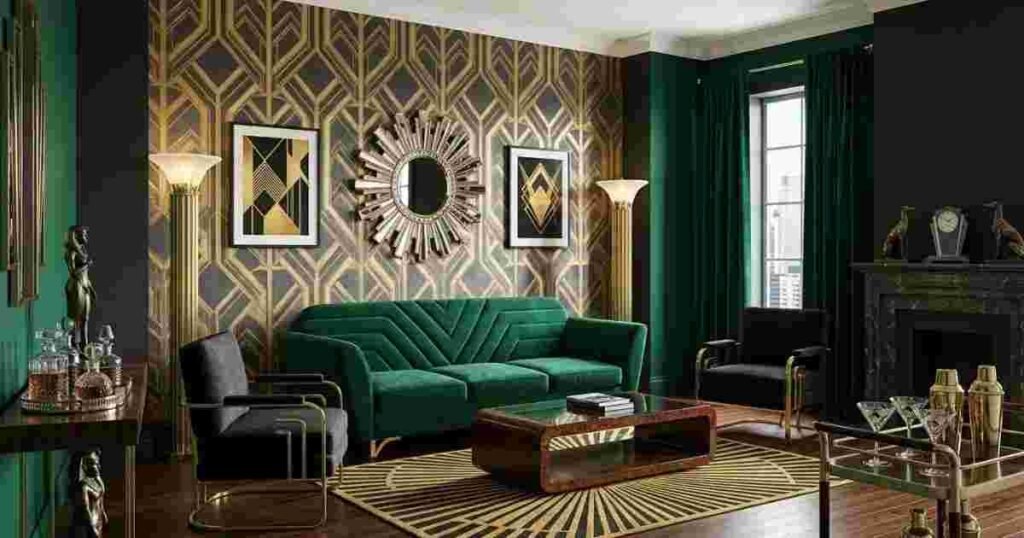
- Use Art Deco to Give Neutral Rooms a Stronger Identity
- Build the Room Around High-Contrast Color
- Let Geometry Create Structure Before Adding Ornament
- Add Metallic and Glossy Finishes With Restraint
- Choose Furniture With Sculptural, Confident Silhouettes
- Use Lighting as Both Decoration and Architecture
- Layer Velvet, Stone, Wood, Glass and Pattern for Depth
- Create Drama Through Symmetry, Then Break It Carefully
- Adapt Art Deco Ideas to Each Room Instead of Repeating a Formula
- Keep the Final Result Edited, Personal and Livable
Art Deco has a useful quality that many contemporary interiors lack: conviction. The style favors strong geometry, polished materials, deliberate symmetry, saturated color, and decorative details that are intended to be noticed rather than quietly disappear into the background. Those characteristics make it particularly effective in homes that feel pleasant but anonymous, where neutral furniture, pale walls, and familiar finishes have produced comfort without much visual identity. An Art Deco approach can introduce contrast without requiring a room to become theatrical or historically literal. The goal is not to recreate a 1920s hotel lobby but to borrow the period’s command of proportion, glamour, craftsmanship, and graphic composition. Used selectively, those ideas can give an ordinary room sharper definition and a far more memorable point of view.
Thank you for reading this post, don't forget to subscribe!- Use Art Deco to Give Neutral Rooms a Stronger Identity
- Build the Room Around High-Contrast Color
- Let Geometry Create Structure Before Adding Ornament
- Add Metallic and Glossy Finishes With Restraint
- Choose Furniture With Sculptural, Confident Silhouettes
- Use Lighting as Both Decoration and Architecture
- Layer Velvet, Stone, Wood, Glass and Pattern for Depth
- Create Drama Through Symmetry, Then Break It Carefully
- Adapt Art Deco Ideas to Each Room Instead of Repeating a Formula
- Keep the Final Result Edited, Personal and Livable
Use Art Deco to Give Neutral Rooms a Stronger Identity
Many modern homes begin with a practical formula of beige upholstery, white walls, light wood, and simple silhouettes. The combination is easy to live with, but it can also make one room resemble the next, particularly when every surface is matte, and every color sits within the same narrow tonal range. Art Deco offers an antidote because it depends on visual hierarchy rather than uniformity. Dark edges frame lighter surfaces, reflective finishes interrupt soft textiles, and geometric forms create a sense of order that can be read from across the room. Even a modest amount of this vocabulary can make a space feel more intentional. The important shift is from decorating with individual objects to composing a room around contrast, rhythm, and focal points.
That does not mean every piece needs scalloped edges, brass trim, or a fan motif. In fact, interiors often feel more sophisticated when only a few unmistakably Deco elements are allowed to carry the style. A streamlined sofa can sit beside a lacquered side table, while a black-framed mirror introduces a sharper architectural line behind them. A neutral rug can remain in place if the lighting, wall art, and occasional furniture provide sufficient visual tension. This selective approach is particularly useful for homeowners who already have a largely contemporary interior and do not want to replace everything. Art Deco becomes a layer of character rather than a decorating costume.
The strongest rooms also distinguish between character and clutter. Art Deco is decorative, but its best interiors were rarely accidental collections of ornate objects. Repetition mattered, whether it appeared through stepped forms, curved corners, vertical fluting, or metallic outlines repeated across several pieces. That principle remains useful because repetition gives bold details legitimacy within a room. One brass accent can look incidental, while brass repeated in a lamp, table edge, and picture frame begins to read as a design decision. Character is created not simply by adding more, but by establishing a visual language and repeating it with discipline.
Build the Room Around High-Contrast Color
Color is one of the fastest ways to introduce Art Deco character because the style handles contrast with unusual confidence. Black and ivory remain a natural starting point, particularly in rooms that need stronger definition without an explosion of color. Deep navy, forest green, oxblood, aubergine, and chocolate brown can perform the same anchoring role while bringing greater warmth and complexity. These darker shades work particularly well against cream, parchment, warm white, or pale stone because the difference in value gives furniture and architectural features clearer edges. Metallic accents can then operate as highlights rather than dominating the palette. The result should feel structured, not merely colorful.
A useful strategy is to assign different jobs to different parts of the palette. One light neutral can cover the largest surfaces, one dark tone can provide weight, and one richer color can create moments of emphasis. A cream room, for example, might use black furniture outlines and emerald velvet on a chair or pair of cushions. Another space might combine warm white walls with walnut, burgundy upholstery, and aged brass. Limiting the number of major colors makes it easier to use them assertively. Art Deco generally benefits from clear decisions, so a concentrated block of color often has more impact than several timid accents scattered around the room.
Contrast can also come from finish rather than hue. A black lacquer cabinet will behave differently from a black linen chair because the first reflects light while the second absorbs it. The same is true of polished marble beside wool, brass beside plaster, or glossy tile beside matte paint. These shifts give monochromatic rooms the depth they often lack without requiring additional colors. Homeowners who are reluctant to use dark paint can therefore create a similarly dramatic effect by combining reflective and tactile surfaces within a restrained palette. In Art Deco decorating, contrast is as much about how a material responds to light as it is about the pigment itself.
Let Geometry Create Structure Before Adding Ornament
Geometric order is one of Art Deco’s most recognizable qualities, but it works best when treated as a compositional tool rather than a collection of motifs. Vertical lines can make a low room appear taller, repeated arches can soften a rectangular space, and stepped forms can give flat walls greater architectural presence. Rugs are especially useful because they can establish the geometry of a seating area without permanent construction. Mirrors, cabinet doors, screens, and paneled walls offer additional opportunities to repeat lines and shapes at different scales. When several elements share related proportions, the room begins to feel coordinated even when the individual pieces come from different periods. Geometry, in that sense, functions almost like invisible architecture.
Wall art is one of the easier ways to bring Art Deco geometry into a room without committing to new furniture or architectural changes. A large composition with strong lines, repeated curves, stepped forms, or contrasting blocks of color can give a plain wall the visual structure associated with the style. It can also help connect elements already in the room, such as a brass lamp, dark wood console, curved chair, or geometric rug. For homeowners looking for that kind of focal point, iCanvas.com is an online wall art marketplace with roots in Chicago, offering work in a range of styles and formats. Those interested in the period’s bold geometry and decorative structure can also explore its selection of Art Deco wall art. Pieces with structured compositions can introduce the style’s graphic character without overwhelming the room. Whatever the source, the strongest choice will usually be artwork whose geometry, palette, or framing picks up details elsewhere in the interior, helping the piece feel integrated rather than added as an isolated statement.
Scale deserves as much attention as pattern. A common mistake is to use several small geometric accessories when one larger gesture would produce greater clarity. An oversized arched mirror, a substantial patterned rug, or a pair of tall fluted cabinets can establish the Deco influence immediately and leave the rest of the room comparatively calm. Large-scale geometry gives the eye something to understand before it encounters smaller details. It also prevents the style from becoming visually fussy, which is especially important in compact homes. When bold shapes are given enough physical space, Art Deco can feel architectural and contemporary rather than ornamental and nostalgic.
Add Metallic and Glossy Finishes With Restraint
Metal is nearly inseparable from the popular image of Art Deco, but too much shine can quickly make a room feel more commercial than residential. Brass, bronze, chrome, nickel, and blackened metal are most effective when they underline forms that already have visual strength. A brass border around a mirror can sharpen its silhouette, while chrome legs can make a heavy chair or console appear lighter. Metallic finishes should therefore be used as punctuation rather than background noise. They catch the light, draw attention to edges, and establish small moments of luxury. Their impact usually increases when they are surrounded by quieter materials.
Mixing metals is possible, although it requires a clear hierarchy. One finish should usually dominate, while a second appears in smaller quantities or in pieces that serve a different function. Warm brass lighting can coexist with darker bronze hardware because the two finishes share a related warmth while retaining enough difference to feel deliberate. Chrome can also work alongside brass when the broader palette contains both cool and warm notes, although the combination demands more care. What tends to weaken the effect is an indiscriminate mixture of several shiny metals with no repetition or relationship. Art Deco may celebrate glamour, but its glamour is organized.
Glossy surfaces deserve similar discipline. Lacquered wood, polished stone, mirrored panels, glazed tile, and high-sheen paint can create the sense of depth associated with Deco interiors because they react visibly to changing light. A single lacquered cabinet against a matte wall can make both surfaces look richer through contrast. Polished stone on a coffee table can perform a similar job in a living room dominated by fabric upholstery and rugs. These materials are most convincing when placed where they can be seen and touched rather than hidden among many competing finishes. A few controlled areas of reflection usually create more sophistication than a room in which nearly every surface gleams.
Choose Furniture With Sculptural, Confident Silhouettes
Art Deco furniture is often remembered for ornament, yet silhouette may be its most useful lesson for contemporary homes. Curved backs, substantial bases, rounded corners, channel upholstery, and strong vertical proportions allow furniture to command space before decorative details are even considered. A barrel chair in a simple fabric can introduce Deco character despite having no metallic trim at all. The same is true of a waterfall console, a pedestal dining table, or a sofa with a gently curved back. These forms look intentional because they have a clear outline. In a room filled with generic rectangles, one or two sculptural silhouettes can create immediate contrast.
The scale of the furniture should feel confident without overwhelming circulation. Art Deco rooms traditionally gave individual pieces enough breathing space for their profiles and finishes to register. That remains a useful principle in smaller contemporary homes, where the temptation is often to fill every wall and corner. A distinctive chair will have more presence if it is not pressed against a cabinet, plant stand, floor lamp, and pile of accessories. Negative space allows curves and stepped edges to be read clearly. It also introduces a sense of luxury because the room appears planned rather than packed.
New purchases are not always necessary to achieve the effect. Existing furniture can often be repositioned, reupholstered, or paired with more decisive pieces to shift the character of a room. A plain dining table may feel dramatically different under a sculptural pendant and surrounded by chairs upholstered in velvet or textured fabric. A simple sofa can gain Deco presence through a curved side table, a polished coffee table, and symmetrical lamps. This approach keeps the room from becoming overly thematic while making the most of investments already in place. The key is to identify which pieces should remain quiet and which should carry the visual argument.
Use Lighting as Both Decoration and Architecture
Lighting is one of the strongest tools available to anyone seeking more character because Art Deco fixtures were designed to be noticed. Globes, tiered shades, fluted glass, sculptural sconces, and symmetrical pendants can introduce period references even when the surrounding architecture is plain. A ceiling fixture can establish a central axis in a living room or dining room, giving furniture a clearer relationship to the space. Wall sconces can frame art, mirrors, fireplaces, or headboards while creating vertical rhythm. Table lamps add another layer, particularly when they combine opaque shades with reflective bases. Instead of treating lighting as an afterthought, Art Deco makes it part of the room’s visual structure.
Layering is critical because decorative fixtures lose much of their appeal when they must provide every lumen on their own. Ambient light can come from a central pendant or ceiling fixture, while task lighting supports reading, working, or dining. Accent lighting then highlights art, stone, shelving, or architectural details. This approach produces the pools of brightness and shadow that make polished materials and dark colors look especially rich. Rooms lit uniformly from a single overhead source often appear flatter, regardless of how expensive the furniture may be. Multiple light sources create the depth that dramatic decorating requires.
The color and diffusion of the light matter as much as the fixture itself. Warm light generally complements brass, walnut, cream, amber glass, and saturated jewel tones, while overly cool bulbs can make these finishes appear harsher. Frosted and opal glass are particularly useful because they soften illumination without removing the fixture’s graphic shape. Dimmer controls give another level of flexibility by allowing a room to shift from practical brightness to evening atmosphere. Art Deco interiors are often associated with nightlife, theaters, hotels, and restaurants partly because their materials were designed to come alive under artificial light. Residential spaces can borrow that sense of drama without sacrificing comfort or function.
Layer Velvet, Stone, Wood, Glass and Pattern for Depth
Texture prevents the high-contrast Art Deco palette from feeling severe. Velvet remains an obvious choice because its pile changes with the light, producing both visual richness and tactile softness. Bouclé, mohair, wool, silk blends, and tightly woven upholstery can play similar roles depending on the room and budget. These fabrics are particularly effective against hard materials such as glass, metal, marble, and lacquer. The contrast makes each surface appear more distinctive. A room becomes more interesting not because every material is luxurious, but because the materials respond differently to touch and light.
Stone introduces permanence and weight, even when used in relatively small quantities. Marble, travertine, granite, and richly patterned engineered stone can appear on coffee tables, consoles, lamp bases, fireplace surrounds, or trays. Strong veining works particularly well in an Art Deco context because it provides natural pattern within the style’s otherwise controlled geometry. Dark stone with pale veining can anchor a light room, while cream or brown stone can soften black furniture and metallic accents. Wood provides another useful counterweight, especially in walnut, ebony-toned finishes, burl patterns, or other species with visible grain. Combining stone and wood prevents the room from feeling too polished or cold.
Pattern should be introduced with a similar sense of hierarchy. A geometric rug might serve as the primary pattern, allowing curtains and upholstery to remain relatively simple. In another room, a patterned wallpaper or upholstered headboard could become the dominant statement while the floor stays quiet. Repeating every possible Deco motif at once tends to weaken the room because there is no clear focal point. Strong interiors distinguish between leading and supporting elements. One pattern can establish the theme while other textures deepen the atmosphere without competing for attention.
Create Drama Through Symmetry, Then Break It Carefully
Symmetry gives Art Deco interiors their sense of ceremony and order. Matching sconces beside a mirror, pairs of chairs facing a sofa, or identical lamps on a console can make even a modest room feel more composed. This works particularly well in homes with few architectural details because symmetry creates a visual center where the building itself may not provide one. The approach also makes bold objects easier to absorb because the repetition creates predictability. A pair of dramatic lamps often feels calmer than two unrelated decorative pieces of similar size. Order gives glamour a framework.
Perfect symmetry, however, can become rigid if it is repeated everywhere. Contemporary rooms benefit from using symmetry as an anchor and allowing smaller elements to break the pattern. Two matching lamps might flank a console while the objects between them vary in height and shape. A pair of chairs may face a sofa, but a floor lamp can occupy only one side of the arrangement. The result preserves balance without making the room feel staged. This tension between order and irregularity gives Art Deco-inspired interiors a more lived-in quality.
The principle is particularly valuable when arranging shelves, mantels, consoles, and bedside tables. Begin with the largest elements and establish a balanced framework before introducing smaller objects. Decorative boxes, books, trays, ceramics, and framed photographs can then add asymmetry within that structure. Leaving some surfaces empty is equally important because negative space allows polished finishes and sculptural objects to register. Deco-inspired decorating should feel edited rather than crowded. A room with character is not necessarily a room with more possessions, but one in which the possessions have clearer relationships to one another.
Adapt Art Deco Ideas to Each Room Instead of Repeating a Formula
Living rooms can usually handle the greatest concentration of Art Deco references because they contain multiple furniture types, lighting sources, and decorative surfaces. A large geometric rug can define the seating area, while a curved chair or polished coffee table introduces a stronger silhouette. Wall art can provide the main block of color, leaving upholstery quieter and easier to update over time. Lighting can then reinforce the room’s geometry through paired lamps or a central pendant. The important point is to avoid distributing equal visual weight to every object. A successful living room needs a focal point, secondary accents, and enough neutral territory for both to register.
Bedrooms often benefit from a softer interpretation. An upholstered headboard with channel detailing or a tall curved profile can deliver much of the style without making the room feel busy. Bedside lamps or sconces can introduce symmetry, while dark wood, brass, or stone adds a richer material note. Bedding should generally remain calmer if the headboard, wallpaper, or rug already carries a strong pattern. Mirrored furniture can work in small quantities, although one reflective surface is often sufficient in a room intended for rest. The objective is to preserve Deco’s polish and geometry while reducing its visual intensity.
Dining rooms, entryways, and powder rooms offer opportunities for greater drama because people spend shorter periods in them. A dining room can support a darker wall color, a sculptural chandelier, a glossy table, or a strong geometric rug without becoming exhausting. An entryway can make an immediate impression through an oversized mirror, narrow console, statement light, and sharply edited accessories. Powder rooms can carry patterned wallpaper, bold stone, metallic fixtures, or high-gloss paint on a relatively small scale. These spaces are useful testing grounds for homeowners who like Art Deco but are uncertain about making a large commitment. Concentrating stronger ideas in transitional or occasional rooms can give the entire home more personality while keeping primary living areas balanced.
Keep the Final Result Edited, Personal and Livable
The strongest Art Deco-inspired homes avoid treating historical accuracy as the goal. A contemporary apartment does not need to resemble a preserved 1930s interior to benefit from the style’s lessons. What matters is the use of contrast, geometry, craftsmanship, proportion, and materials that reward close attention. Personal possessions should remain visible because they prevent a stylized room from feeling like a showroom. Books, collected objects, photographs, inherited furniture, and contemporary art can coexist comfortably with Deco elements when the palette and proportions connect them. Style becomes more convincing when it supports the life already taking place in the room.
Editing is therefore as important as acquiring. Once several strong elements are in place, removing weaker accessories may improve the room more than buying another statement piece. Look for objects that repeat neither the color palette nor the geometry and consider whether they add meaningful texture, function, or sentiment. Surfaces do not need to be filled simply because they are available. A polished console with one lamp, a sculptural bowl, and a framed piece of art may have more impact than the same console covered with a dozen small objects. Restraint gives expensive and inexpensive pieces alike more visual authority.
Art Deco remains relevant because it offers something many restrained contemporary interiors increasingly need: memorable contrast. Its dark outlines, rich surfaces, structured patterns, curved silhouettes, and reflective details can turn an anonymous room into one with an identifiable point of view. The style is flexible enough to appear through a single mirror or light fixture, yet strong enough to guide an entire home’s palette and material choices. Homeowners do not need to embrace every hallmark at once to benefit from its discipline. A few well-chosen elements, repeated deliberately and balanced with quieter surroundings, can create far more character than a room full of unrelated decoration. The most successful result feels neither like a period set nor a passing trend, but like a home whose visual decisions have been made with confidence.