

Introduction
A healthy lawn always conveys pleasure in the mind around the house or yard. Offers a friendly outside space to relax, entertain and spend quality time with family and pets. A level and smooth lawn is preferable for anyone to be comfortable and usable. Uneven ground can cause a host of problems, from poor drainage to mowing difficulties to uneven grass growth and even a tripping hazard.
Thank you for reading this post, don't forget to subscribe!Why is a Flat Lawn Important?
Having a level lawn is important to the health and look of your landscape. A fine levelled surface can pass away water and prevents formation of stagnant form that can cause the production of producing poor quality root of grass by attracting lawn pests and diseases. This also causes human problems by providing favourable conditions for the production of mosquitoes and other soil- and grass-borne diseases. Even surfaces help to distribute water, nutrients, and sunlight more evenly throughout the field, resulting in regular grass growth and less chance of barren or patchy land. Levelling can help to align any bumps and dips that could reduce the risk of tripping and falling. As a result, the lawn becomes a safer place for children, pets, and outdoor activities.
Read More: Yellow Grass Problems and Treatment to Make Lawn Green Again
Causes for an Uneven Ground
There are many natural and man-made causes as to why grass may grow uneven over time.
Structural or Physical Problems:
- An uneven surface of soil may not be compacted evenly. It happens in newly added soil when the foundation settles at a different rate around the ground.
- On rainy days, heavy rainfall causes this problem by draining out fine soil particles, and heavy clay remains in the ground as a crack and rugged form.
- In cold climates, water freezes and expands in volume, taking the soil upward. When the ice thaws, the soil mixes and makes an uneven surface.
- Various types of grass planted together, or grown in thicks, make the grass in cluster form and feel like bumps when walking or mowing over it.
Biological Problems:
- Pests and Insects: Grubs, moles, voles, skunks, and raccoons feed and plough on the root area of grass, making pores in the soil, raised ridges, and loosening.
- Earthworms are beneficial for grass but can cause small issues. They dig the soil and make piles that create dissimilarities.
Manmade Maintenance Causes:
- Mowing improperly at different heights, too short and too long, makes the lawn grass uneven and pull out directly to the elements, causing cracks or erosion.
- Improper watering causes the root soft and spongy, leading to an uneven surface.
How to Diagnose the Causes
Before marking a patchy lawn, it is necessary to find the actual diagnosis as why the patchiness exists. The following methods can help identify the correct cause of the problem.
Microtopographical Identification (Mapping by Spatial & Grid):
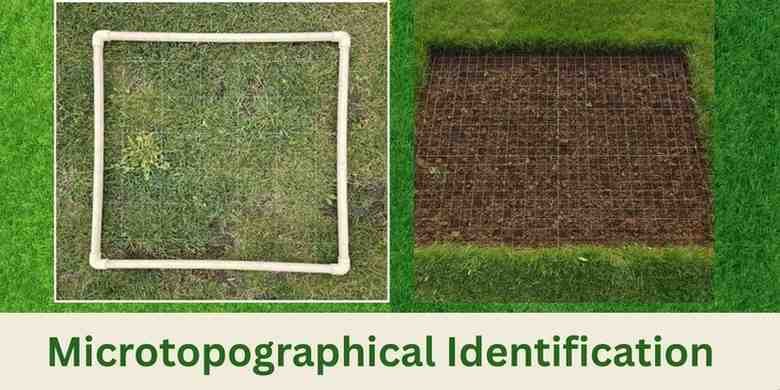
Use a 5×5 square feet grid on your lawn, and a widespread area can be measured where the exact location of specialized depression remian by walking systematically.
Mechanical Diagnosis (Penetration):
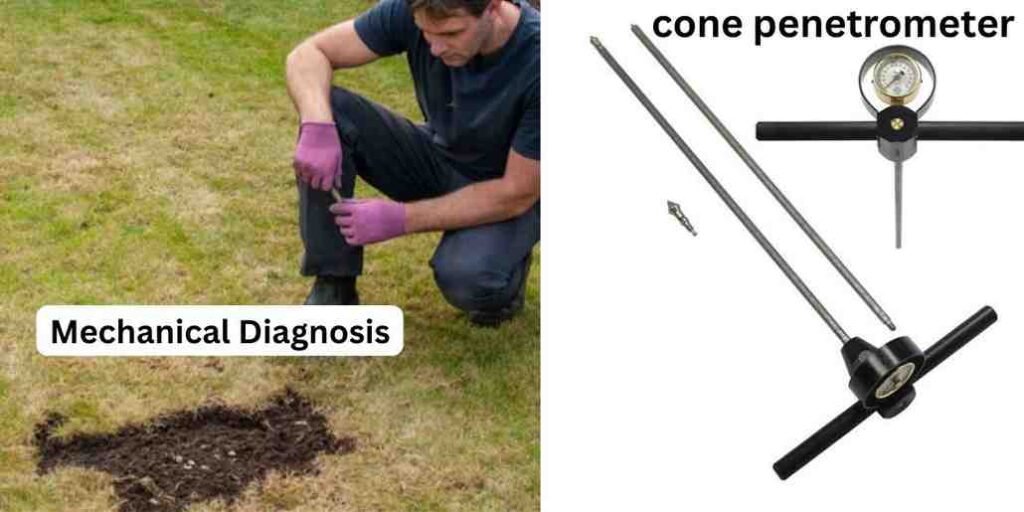
Use a metal soil probe called a cone penetrometer and push it into the soil to identify the actual differentiation of soil compaction in the whole lawn area. You can easily find out where soil is less or more concentrated.
Volumetric Moisture:

Simply check after a heavy rainfall. By this easily identify where water is stagnant or expelled instantly. Constantly waterlogged soil leads to structural failure, leading to deep holes. On the other hand, chronically dry soil may ruin a flat surface.
Thatch Sampling:

Take a soil sample from 3-4 inches deep and check it. Healthy lawn soil is indicated to be ¼ to ½ inch thick. Uneven lawn soil shows a spongy feeling and is bumpy underfoot.
Diagnosis on The Severity:
There are three types of severity: mild, moderate, and high.
Here is the diagnostic severity scale organized into a clean, tabulated format for easy reference:
| Severity Level | Profile Depth (Dips/Bumps) | Typical Diagnostic Visuals | Primary Agronomic Culprits |
| Mild | Less than 1 inch (< 2.5 cm) | Minor surface ripples; lawn mower slightly “scalps” the grass in isolated high spots. | • Natural soil settling over time • Localized earthworm castings • Minor frost heaving or seasonal soil shifting |
| Moderate | 1 to 2 inches (2.5 to 5 cm) | Visible depressions; walking feels noticeably bumpy; mower consistently cuts grass unevenly. | • Uneven thatch accumulation (spongy organic layer) • Localized foot traffic or pet-induced soil compaction • Minor surface water runoff paths |
| High | Greater than 2 inches (> 5 cm) | Significant, hazardous ruts or deep holes; standing water puddles after rain; mower blade strikes dirt. | • Under-surface structural collapse (e.g., rotting tree roots or stumps) • Subsurface erosion from broken irrigation pipes/drainage lines • Poor initial construction or grading failure |
How to Repair
● Fill in valleys: Fill low sections with a combination of dirt and compost, then level with a rake.
● Remove high locations – Remove excess dirt from high locations and re-turf as needed.
● Top dress the lawn If you have a few little low places you may even them out with a modest layer of levelling mix.
● Aerate Compacted Soil — Aeration of compacted soil allows for better drainage, root growth, and overall grass health.
● Fix drainage sources—Make sure waterlogging doesn’t exist and fix stagnant water passages to drain out.
How to Level Your Lawn
To level your lawn firstly mow the lawn deeply and remove all extra particles or things from the surface. Aeration is properly applied, especially in compacted soil, so that all soil structure gives the same look. If required, apply a layer of topsoil or levelling mix over low spots and rake level. Spray water gently to settle the soil evenly. If the surface seems to be uneven, repeat the process until corrected.
When Upgrade Your Lawn?
Time is crucial when it comes to grass levelling. The grass has to be actively growing so it can bounce back rapidly and push through the fresh soil you put in. Cool season grasses are best seeded in early spring or early fall when weather is mild and moisture is generally available. Warm-season grasses are best dethatched in late spring or early summer. Avoid excessive heat, drought, heavy rain or dormant conditions since these circumstances slow down and make the procedure inefficient. Pick the proper season and your grass will bounce back faster and be smoother and healthier longer.
Conclusion
Lawn levelling is a simple, practical way to increase the beauty and health of your lawn and avoid small problems turning into expensive headaches. Proper caring and checking, you can make your lawn very aesthetic and amazing, which is suitable for planting, playing, or walking smoothly.
FAQs
1) How can I tell whether I need to level my lawn?
Answer: If you see dips, lumps, pools of water, uneven grass growth, or difficulty while mowing, then your lawn probably needs levelling.
2) Do I pay someone or do I do it myself?
Answer: You may undertake basic levelling yourself, but if there are serious unevenness or drainage concerns, call in an expert.
3) How can I level my lawn without dying the grass?
Answer: Of course. If the irregularity is not too great, you may rectify it using a thin coating of levelling substance. In the deeper areas, you will have to dig up the grass and replant it.
References:
- Spatial Variation in Turf Surface Properties of Polo Pitches: A Case Study of Different Handicaps” (MDPI / PMC)
- Genetic Variability of Traffic Tolerance and Surface Playability of Bermudagrass” (ASHS Journals)
- Surface testing 101: why it matters” (SPORTENG Technical Reports)
- Prediction of Turfgrass Quality Using Multispectral UAV Imagery and Ordinal Forests” (MDPI)