
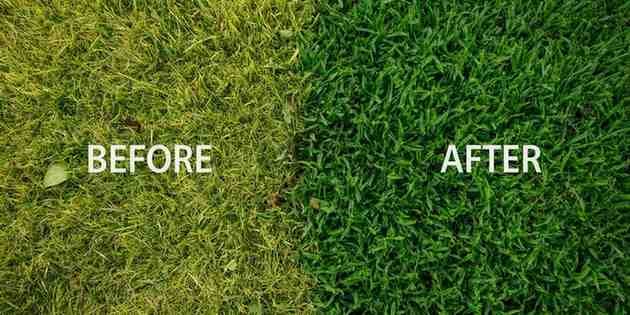
It is frequently seen that lawn grass turns yellow for many reasons. Sometimes the greenish part of the plant produces a small or low amount of chlorophyll due to unnatural conditions of water, nutrients, soil structure, pathogens, or insects. Most farm owners have no idea about the right diagnostic methods for the actual causes of the disease. They try random methods to solve one by one, but most of effortless and time consuming. For example, applying nitrogen fertilizer on iron-deficient turf or watering a fungus-infected lawn even more makes the yellowing worse.
Thank you for reading this post, don't forget to subscribe!- What Yellow Grass Is
- Nitrogen Deficiency Yellow Lawn
- Iron Chlorosis
- Overwatering and Underwatering
- Soil Compaction and Poor Drainage
- Lawn Fungal Diseases Cause
- Grub and Pest Damage Grass
- Mowing Mistakes Cause
- Seasonal Dormancy: When Seem to Normal
- Dog Urine and Chemical Burn
- Yellow Grass Problem Diagnostic Shortlist
- Conclusion
What Yellow Grass Is
Yellowing, or chlorosis is simply the visible yellowing of yellow grass plant which lack of much chlorophyll production. But the pattern of that is which parts are affected, where on the blade the color is getting fades, whether it’s a similar or a defined patch is a diagnostic method. Treat the lawn the right way rather than just anyone.
Before applying any remedy, ask the three questions about:
1. Is the yellow color spread evenly over the whole lawn, or irregularly?
2. Are oldest or newly formed leaves affected on the blade?
3. Has anything changed recently by mowing height, watering schedule, weather condition, or dog feces in the yard?
Those answers allow for fast detection, and the answer framework used throughout the rest of this article.
Nitrogen Deficiency Yellow Lawn
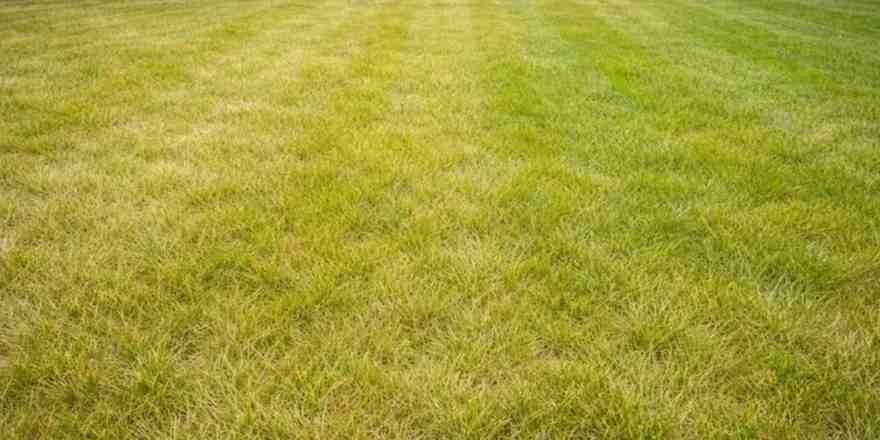
Nitrogen is the main nutrient which needs high quantity. Soils can’t supply nutrients continuously on their own without regular application. Nitrogen ion is effective for plant growth older to newer and in most cases weak leaves and roots are getting stronger with with more of its application. It acts as a chemical messenger that enriches the plant’s regeneration. That’s why nitrogen deficiency shows up in yellowish leaves fast; the leaves turn lower and get older faster. Without proper correction, the whole lawn falls dull yellow-green, with slow growth and thin turf.
It gives differences on soil types. In clay soils of the Midwest, nitrogen binds with organic matter and is released slowly. So deficiency often appears in early spring before microbial activity in high level. In sandy soils of the Southeast, nitrogen drains quickly with heavy rainfall. So deficiencies can reappear within weeks of application, especially in the humid summer season.
Treatment: Apply a slow-release nitrogen fertilizer following to your grass types. Cool-season grasses like Kentucky bluegrass and fescue typically need 2 to 4 pounds of nitrogen per 1,000 square feet/ year, while warm-season grasses like Bermuda or Zoysia need more this time, especially in the growing stage. Selective applications across the growing season rather than regular heavy dose and always water prevent burn.
Iron Chlorosis
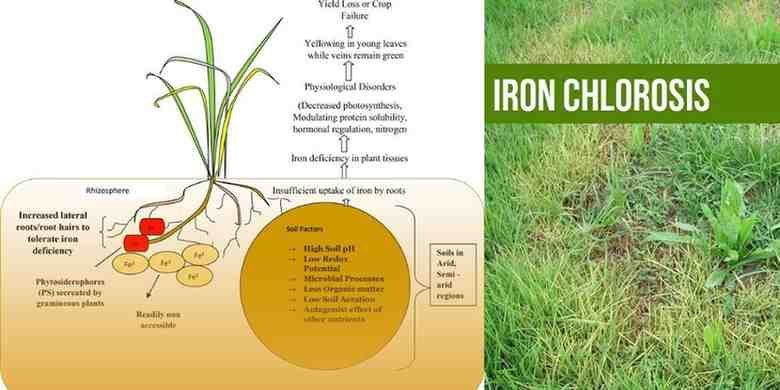
Iron chlorosis is a condition that homeowners and landscapers may confuse with nitrogen deficiency and it is costly to maintain because the treatments are opposite. Research from Texas A&M Agri-Life Extension on Turf grass shows that iron deficiency develops in new growth stems and leaves, producing a distinctive pattern. The tissue in between the veins gets yellow while the veins themselves stay green, giving a striped look. In severe cases, the youngest blades can cleanse almost white.
The basic difference can be found out by knowing some changes between Iron chlorosis and Nitrogen deficiency. Nitrogen deficiency = old leaves yellow first. Iron chlorosis = young leaves and veins look yellow first. Extension of turf grass examiners referenced by North Dakota State University’s Agriculture program, note that low-iron turf shows a mottled and patchy yellow-green appearance throughout the lawn, while nitrogen-deficient turf gets yellows more uniformly.
Iron chlorosis is not the iron shortage problem; it is mainly a chemical problem of the plant. High soil pH (above 7.0–7.2), often found in soils comes from limestone or in over-limed lawns, iron can not break down into a chemical form, and plant can’t absorb. Compacted soil, overwatering, and cold, wet conditions in early spring ruin it.
Treatment: Never add nitrogen to chlorotic turf untill it turns green fully. Extension research is consistent that this often makes the yellowing again. Instead of it, apply a chelated iron or ferrous sulfate foliar spray for quick, temporary green-up, and notify the root. Elemental sulfur applications (roughly 5 pounds per 1,000 square feet) turn soil pH lower over a season or two. Core aeration before treatment improves results.
Overwatering and Underwatering
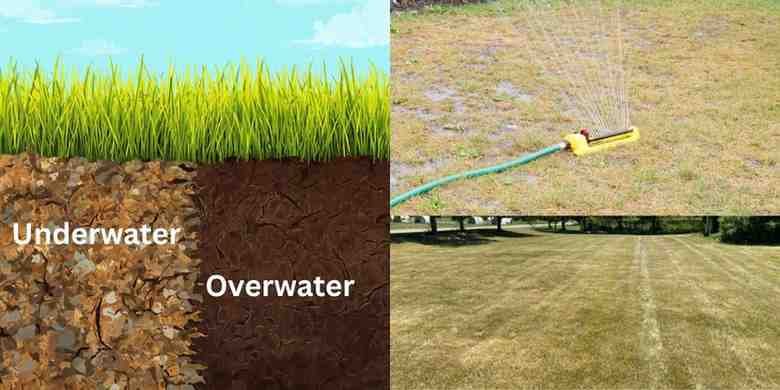
Both applied extremes level raise yellow grass; biological mechanisms are different. The underwater problem is due to a lake of moisture. Here’s leaf plates fold or rolling, color dries to a dull blue-grey-yellow, and footprints stay visible for a long time after you walk across on it.
Overwatered grass yellows for a different reason entirely. Saturated soil expels oxygen from the root. Roots need oxygen for respiration and to transport nutrients. So a waterlogged lawn can show classic nutrient deficiency even the soil is fertile. Overwatering also promotes shallow root systems and creates damping form, humid microclimate that fungal pathogens attract in.
Treatment: Most of cases of lawns need about 1- 1.5 inches of water/ week, including shallow rainfall. Give it through one or two deep sessions rather than daily light sprinkles. Deep and infrequent watering directs roots to grow downward, where soil moisture is more stable. Check soil moisture 3–4 inches down with a probe before watering at all.
Soil Compaction and Poor Drainage
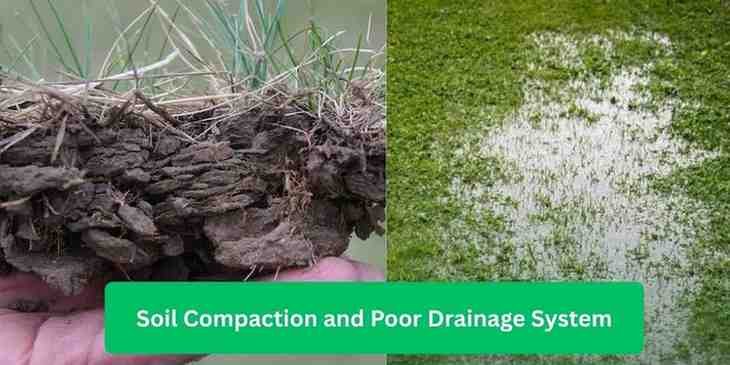
This is a physical problem of your lawn. Frequent footing, mowers application, and the dense clay soils common in suburban developments across much of the U.S. suppress soil particles together firmed out the pore space that air, water, and roots depend on. Compacted soil fails root depth, limits nutrient and oxygen uptake, and water stagnant after rain. All of these issues produce yellow, thin, weak-looking turf often in low spots in the yard.
Treatment: Core aerate compacted lawns at least once a year. Early fall for cool-season grasses, late spring for warm-season grasses trudging actual plugs of soil. Aeration with compost improves structure over time, and consider adding organic matter to heavy clay soils to improve drainage permanently. For chronic low spots, installing a simple drainage solves the problem at the source.
Lawn Fungal Diseases Cause
Fungal disease is one of the most common reasons a healthy-looking lawn suddenly develops yellow or tan patches, and each major disease has a fairly distinct fingerprint.
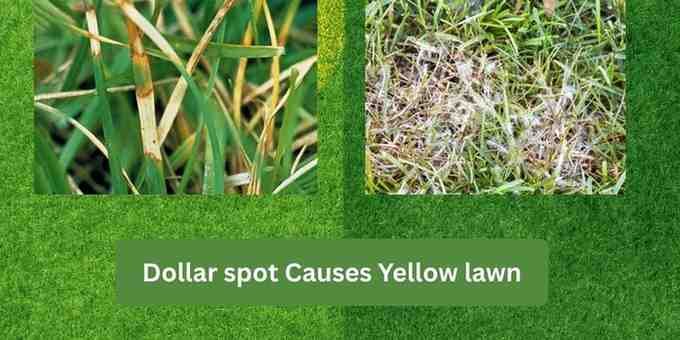
Dollar spot, caused by the fungus Clarireedia jacksonii (formerly classified as Sclerotinia homoeocarpa), produces small, straw-colored, silver-dollar-sized spots that can merge into larger irregular patches when severe. It favors warm days, cool humid nights, heavy dew, and turf that’s low on nitrogen. A combination common across much of the eastern and southern U.S. in late spring and summer.
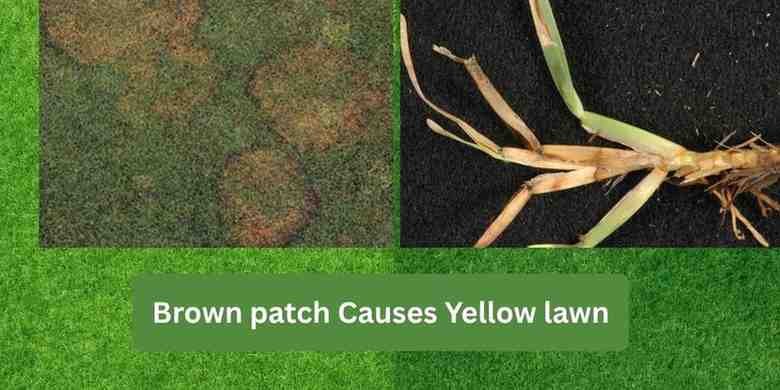
Brown patch, caused by Rhizoctonia solani, shows up as roughly circular patches of yellow-to-brown grass, sometimes with a “frog-eye” pattern of a green center ringed by browning turf. It thrives when nighttime temperatures stay above 70°F and humidity is high, especially on lawns that are overwatered or overfed with nitrogen during summer heat.
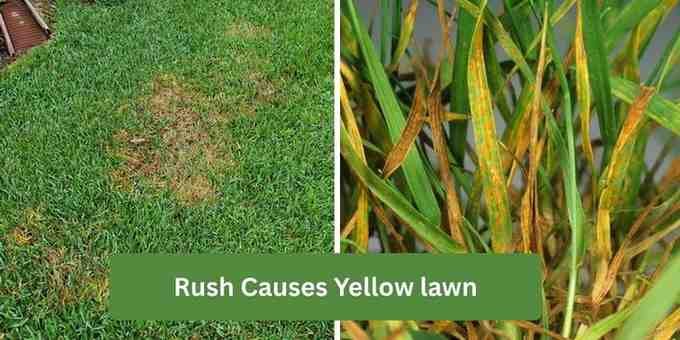
Rust coats grass blades in an orange-yellow powdery residue that rubs off on shoes and clothing, giving the whole lawn a dusty yellow-orange cast from a distance. It typically strikes slow-growing, stressed turf often during intense cool, wet weather or in shaded, poorly fertilized lawns.
Treatment: Improve air circulation and reduce leaf wetness by watering early in the morning rather than evening, and avoid heavy nitrogen applications during peak disease-favorable weather. For dollar spot and brown patch, a fungicide containing azoxystrobin, propiconazole, or myclobutanil applied at the first sign of spotting can stop the spread; for rust, correcting underlying fertility and mowing frequency usually resolves it without chemical treatment.
Grub and Pest Damage Grass
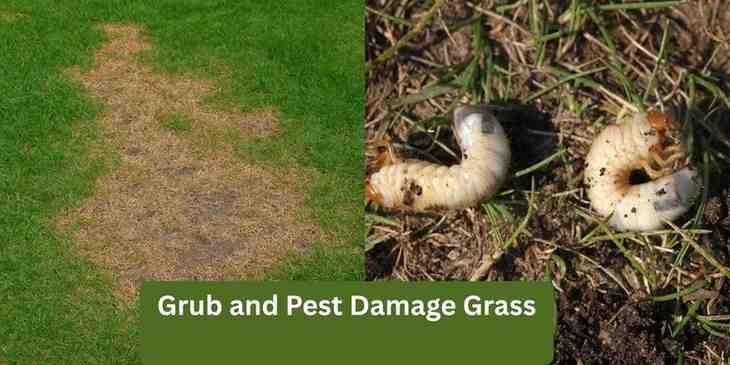
When yellow patches lift away from the soil, insects are usually the cause. White grubs, the larvae of Japanese beetles and June bugs, feed on grass roots, destroy the plant’s ability to take up water and nutrients. Chinch bugs feed at the soil surface and are especially active in hot, dry, sunny areas of the lawn, where their damage is often mistaken for drought stress.
A simple grub check: cut a foot-square section of turf about two inches deep and peel it back. Finding fewer than five grubs generally doesn’t require treatment, since healthy, well-irrigated turf can tolerate that level without visible damage.
Treatment: Biological control is effective and lower risk than broad spectrum insecticides. Entomopathogenic nematodes particularly Heterorhabditis bacteriophora for grubs and Steinernema carpocapsae for caterpillar pests actively look out larvae in the soil and can reduce populations significantly within one to two weeks. Milky spore disease offers slower, longer-term suppression of Japanese beetle grubs specifically. Chemical grubicides remain an option for heavy infestations. But this is a last resort given their impact on pollinators and other beneficial insects.
Mowing Mistakes Cause
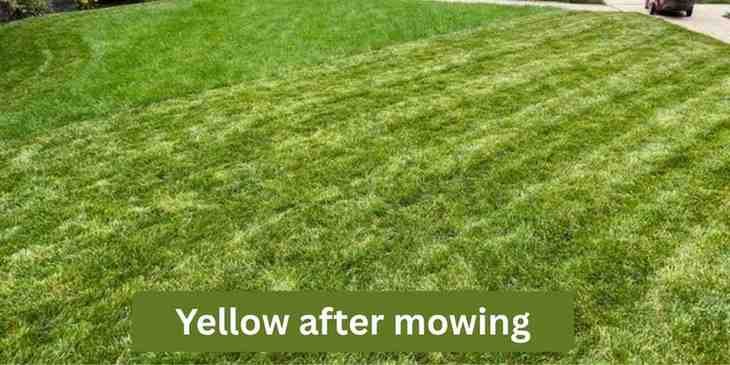
Mowing is the frequent maintenance task on a lawn. Scalping- Cutting the grass dramatically shorter than its recommended height in one pass. It removes too much leaf surface at once, shocking the plant and forcing energy transport from roots into leaf regrowth. That regrowth phase sometimes seem to yellow or pale flush because the plant can’t pull up iron and other nutrients fast enough to keep green with new growth.
When a mower tears the grass rather than slicing with blades, then the problem is created. After that, the grass leaves get yellow to brown and grass pathogens enter here also.
Treatment: Never remove more than one-third of the blade height in a single mow. Sharpen mower blades at least once or twice per season, and raise your mowing height during hot, dry stretches to keep more leaf surface for photosynthesis and shade the soil to conserve moisture.
Seasonal Dormancy: When Seem to Normal
Not every yellow lawn is a problem. Cool-season grasses like Kentucky bluegrass and fescue can go dormant and turn straw-yellow during extended summer heat and drought as a survival mechanism, conserving resources in the crown and roots rather than the leaves. Warm-season grasses such as Bermuda and zoysia naturally go dormant and turn tan-yellow with the first hard frosts of fall, staying that way until soil temperatures warm in spring.
Uniformity and timing are important: dormancy affects the entire lawn evenly and aligns with a seasonal weather pattern, not patches, rings, or stripes tied to traffic, irrigation lines, or pet activity. Dormant grass typically greens back up on its own once favorable conditions return, with no fertilizer or fungicide required.
Dog Urine and Chemical Burn
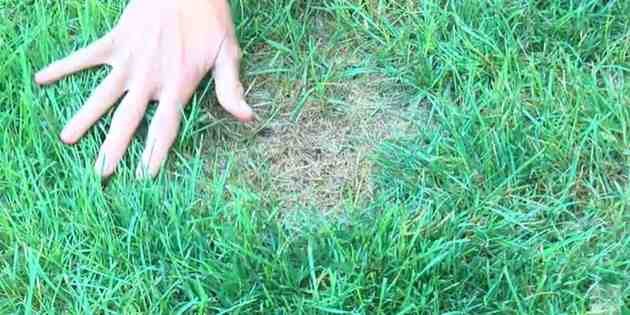
A straw brown color in the center of defecated dog urine in a lawn called a “bullseye” looks like a circular or ring like structure. Urine has ammonia salts that release nitrogen that directly burns the grass when contacted. The diluted nitrogen acts like a mini fertilizer application, greening up ring edges. Some chemical substances such as spilt fertiliser, gasoline, or de-icing salt, produce a similar burn pattern.
Treatment: Flush with water on the spot within 15 minutes, which dilutes the ammonia salt and spreads the surroundings before serious damage. For lawns with multiple dogs, training pets allows a selected area. Seeding again in dead bullseye centres or selected salt-tolerant grass like fescue over the whole lawn solves the urine problem again.
Yellow Grass Problem Diagnostic Shortlist
| Symptoms | Likely Cause | Solution |
| Older/lower leaves yellow, uniform across lawn | Nitrogen deficiency | Slow-release nitrogen fertilizer |
| Youngest leaves yellow with green veins | Iron chlorosis | Chelated iron spray + soil pH correction |
| Footprints linger, blue-grey tint | Underwatering | Deep watering, 1–1.5 in/week |
| Yellow despite frequent watering, soggy soil | Overwatering / poor drainage | Reduce watering, aerate, and improve drainage |
| Yellow in high-traffic paths or low spots | Soil compaction | Core aeration + compost topdressing |
| Straw-colored silver-dollar spots | Dollar spot fungus | Fungicide + balanced nitrogen |
| Circular brown/yellow rings, frog-eye center | Brown patch fungus | Reduce watering/nitrogen, fungicide if needed |
| Orange-yellow dust on blades and shoes | Rust fungus | Improve fertility and mowing frequency |
| Irregular dead patches, turf lifts like carpet | Grub damage | Beneficial nematodes or grubicide |
| Yellow in sunny, dry zones, fine webbing | Chinch bugs | Nematodes, reduce drought stress |
| Pale yellow flush after a short mow | Scalping | Raise mowing height, follow one-third rule |
| Whole lawn evenly tan/yellow, season-aligned | Dormancy | No action needed; will green up naturally |
| Brown center, green ring, circular | Dog urine | Flush with water, reseed the center. |
Conclusion
Every problem has a solution. But firstly, find out the actual cause and study research on it and apply remedies to solve it. Think about what’s actually happening in your soil? Diagnose the correct way; otherwise, all invested money times would be depreciated. A basic soil test, such as soil pH, organic matter, and nutrients such as nitrogen, phosphorus, potassium, and iron, is available through most state university extension offices for a gentle fee. Try to detect the exact reason before applying any treatment, approximately, otherwise, all should be avoidable.