
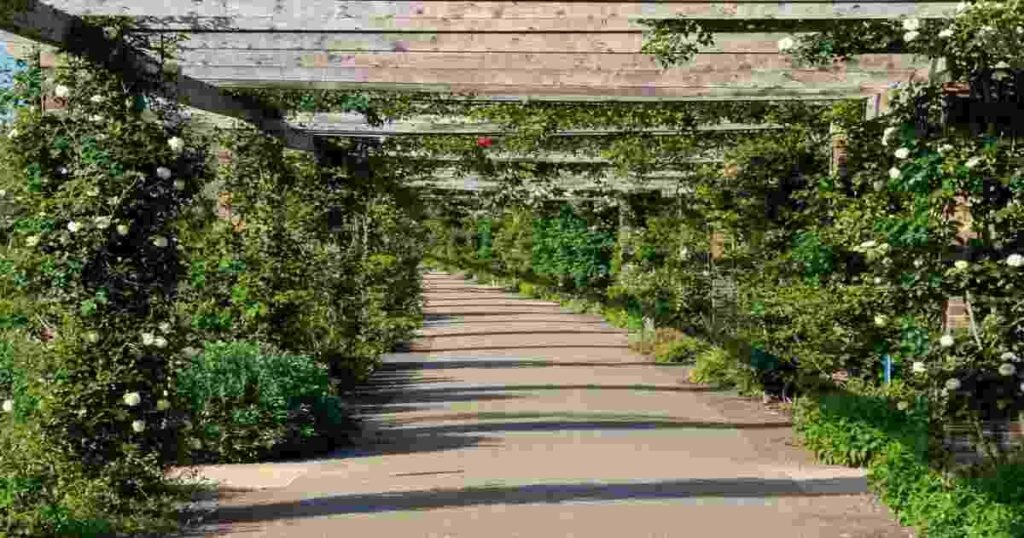
Grass can grow under a pergola, but only if the roof lets enough sun through. An open-slat pergola with a shade-tolerant grass usually works. A solid or fabric roof rarely does, and no amount of seed, fertilizer, or watering will change that. An adjustable louvered roof sits in between, because you decide how much light reaches the ground. The grass you choose matters, but the roof decides whether it has a chance.
Thank you for reading this post, don't forget to subscribe!How much sun does grass actually need?
Extension services agree on a rough floor. Clemson’s Home and Garden Information Center puts it plainly: if an area gets less than four hours of sunlight a day, it is too shady for grass to grow well. NC State uses the same line, describing less than four hours, or less than half of open sunlight, as too shady for turfgrass. Below that point, grass makes too little food to keep up. The blades stretch and thin, disease takes hold in the damp shade, and moss and weeds fill the gaps.
Grasses also differ widely in how close to that floor they can live. Mississippi State ranks them by light need from highest to lowest: Bermudagrass needs the most light of any maintained turf, followed by carpetgrass, bahiagrass, zoysiagrass, centipedegrass, Kentucky bluegrass, tall fescue, and red fescue. That order is the starting point for any shaded spot, including the ground under a pergola.
What each roof does to the light
An open-slat pergola, the classic wood or metal frame with rafters across the top, breaks the sun into moving stripes rather than blocking it. How much shade it casts depends on the slat size and spacing, and wider gaps let more light through. Because the stripes move across the ground as the sun travels, most of the lawn underneath still gets direct light for part of the day. This is the roof most likely to keep grass alive.
Fabric canopies and shade cloth are sold by the percentage of light they block, commonly from about 50 percent for moderate shade to 90 percent for heavy shade. Solid roofs, including most polycarbonate panels, cut light further and also stop rain. That second point is easy to miss. Ground under a covered roof sits in a rain shadow, much like the dry strip under a house eave, so it needs regular watering even when the weather is wet.
Adjustable louvered roofs are the one design that changes with the season. The aluminum louvers tilt open to let sun and rain through and close flat to shed water, which drains away through a downspout in one of the posts. With the louvers open on mild days, the ground can get close to the light of an open-slat roof. Closed for a summer of afternoon parties, it behaves like a solid roof. If keeping grass underneath matters, louvered pergolas with adjustable roofs are the only structures that let you manage light and water for the lawn rather than accept whatever the roof allows.
The best grasses for a partly shaded pergola
In cool-season areas, the fine fescues are the strongest choice. Iowa State calls them the most shade-tolerant cool-season turfgrasses, and NC State rates their shade tolerance as excellent. Tall fescue is the next step down, and Clemson notes it can manage with as little as five hours of sun. Kentucky bluegrass and perennial ryegrass struggle in shade, so a sunny-lawn seed mix is a poor fit under a pergola.
In warm-season areas, St. Augustinegrass is the most shade-tolerant option, though Clemson says it still needs four to six hours of sun to thrive. Cultivar matters here. The University of Florida IFAS lists Palmetto, Seville, and CitraBlue among the most shade-tolerant, while the common Floratam is significantly less so. Fine-textured zoysias handle light to moderate shade, and Bermudagrass, with what Clemson calls extremely poor tolerance to any shade, should be avoided entirely.
Whatever you plant, care for it as a shade lawn. Mow higher, around three to three and a half inches for cool-season grass. Use less nitrogen, since Clemson recommends cutting the rate by a half to two-thirds in heavy shade. Keep foot traffic down where you can, because a pergola tends to concentrate it, and seed cool-season grass in early fall when the light and temperatures favor it.
When to stop fighting it
Under a solid roof, a heavy canopy, or a dining set that never moves, the honest answer is to stop asking grass to grow. Shade ground covers such as ajuga and mondo grass tolerate some foot traffic, while plants like sweet woodruff are better kept to the edges where nobody walks. For the main seating area, permeable pavers or stone set without mortar give a clean, level floor that still lets water soak into the soil. Most homeowners who switch find the space works better for how a pergola is actually used.
Planning a pergola? Choose the roof with the ground in mind
If you have not built yet, decide what you want underneath before you pick the roof and budget for it. Our guide to how much a pergola costs breaks prices down by type. For a 10 by 12 foot kit before delivery and installation, fabric canopies run about $310 to $901, manual louvered roofs about $1,487 to $3,287, and open-slat wood about $3,674 to $6,185. A lawn underneath points you toward open slats or a louvered roof. A patio underneath frees you to choose any roof you like. Sources: Clemson HGIC (Growing Grass in Shade; St. Augustinegrass), NC State Extension (Selecting and Managing Lawn Grasses for Shade), Iowa State Extension (Growing Grass in Shady Areas), Mississippi State Extension (P2892), UF/IFAS (EP072), and The Pergola Kit cost guide. Author: Tony, The Pergola Kit.