
- What's Actually at Risk Outside
- Camera Placement for Outdoor Spaces
- Lighting Does More Work Than People Expect
- Fencing and Access Points as a Security Layer
- Alarm Systems Extend Outdoors Too
- Seasonal Considerations Worth Planning Around
- Insurance Documentation for Outdoor Property
- Making the Outdoor Security Plan Part of the Landscaping Plan
Home security conversations gravitate toward the house itself—door locks, window sensors, and a camera aimed at the porch. Meanwhile, the yard, the shed, the detached garage, and everything stored outside the four walls of the house often go completely unaddressed, even though a surprising amount of home value sits outside in the form of lawn equipment, tools, patio furniture, and increasingly, expensive landscaping installations like irrigation controllers and outdoor lighting systems. A homeowner who’s invested real money and years of effort into a well-maintained yard has a security gap that most standard home alarm setups never touch.
Thank you for reading this post, don't forget to subscribe!- What's Actually at Risk Outside
- Camera Placement for Outdoor Spaces
- Lighting Does More Work Than People Expect
- Fencing and Access Points as a Security Layer
- Alarm Systems Extend Outdoors Too
- Seasonal Considerations Worth Planning Around
- Insurance Documentation for Outdoor Property
- Making the Outdoor Security Plan Part of the Landscaping Plan
What’s Actually at Risk Outside
A quick inventory of what typically sits in a garage, shed, or side yard makes the exposure obvious: riding mowers, string trimmers, pressure washers, generators, bikes, and increasingly, battery-powered outdoor power equipment that’s become a specific target for theft precisely because lithium battery packs hold resale value on their own. Add in irrigation system controllers, smart outdoor lighting hubs, and any built-in features like a fountain pump or pool equipment, and the outdoor footprint of a well-appointed property can represent a meaningful fraction of total home value—all of it typically sitting outside the coverage area of a standard indoor-focused alarm system.
Camera Placement for Outdoor Spaces
Cameras aimed exclusively at doors and the driveway miss most of what actually happens in a yard. A more complete outdoor camera plan usually covers the following:
- Detached structures — sheds and garages, which are frequently the actual target rather than the main house, since they’re often less secured and further from where anyone would notice activity
- Side and rear yard access points — gates, low fence sections, or any spot where someone could enter without walking past the front of the house
- Equipment storage areas—even an open-air spot where a mower or tools are kept between uses benefit from camera coverage, since visible surveillance is a meaningful deterrent on its own
- Garden and landscaped areas with lighting or irrigation infrastructure — expensive installations that represent real investment and are easy to overlook when planning camera coverage
Solar-powered cameras have made covering these secondary areas considerably more practical than before, since running power to a shed or a back corner of a large property is often more expensive than the camera itself.
Lighting Does More Work Than People Expect
Motion-activated lighting around a yard’s perimeter, near a shed, or along a side gate remains one of the most cost-effective deterrents available, and it pairs naturally with landscaping work that’s already being planned. Coordinating outdoor lighting placement with a broader security plan — rather than treating landscape lighting and security lighting as two unrelated projects — tends to produce better coverage than adding security lights as an afterthought once the landscaping is already finished and fixtures are in place.
Fencing and Access Points as a Security Layer
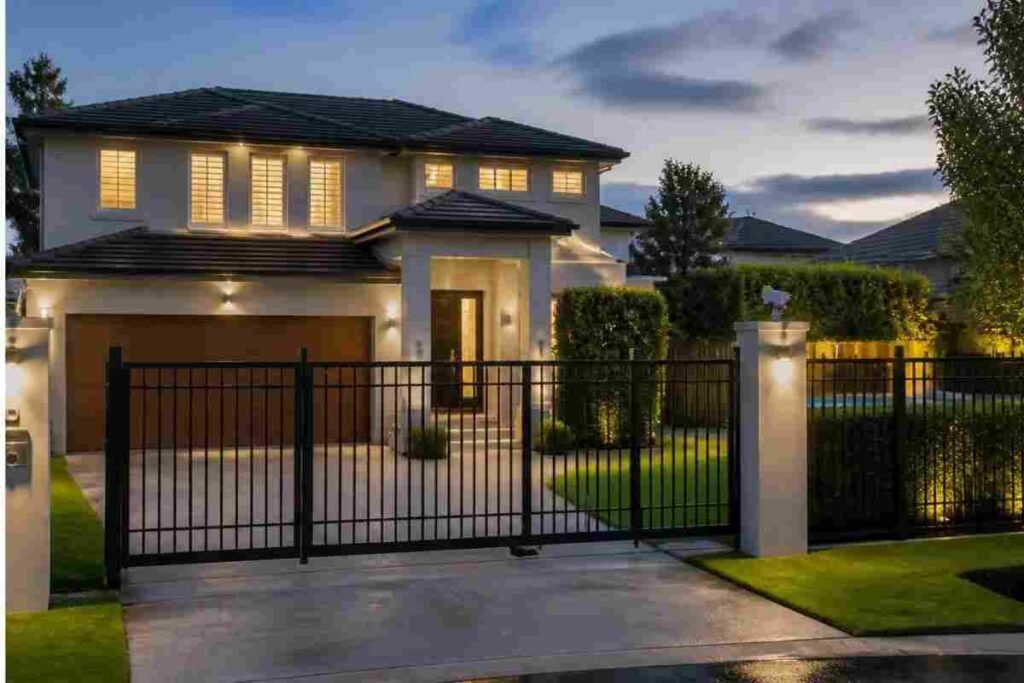
A well-maintained fence line does double duty as a landscaping feature and a security boundary, but only if gates are actually secured and gaps are addressed. It’s common for a fence to look complete while an old gate latch barely functions, or vegetation has grown over a low section in a way nobody’s noticed because it’s not part of the regular mowing route. A periodic walk of the entire property perimeter — the same kind of walk a landscaper might do for maintenance purposes — is a natural opportunity to also check for security gaps that don’t show up from inside the house.
Alarm Systems Extend Outdoors Too
Modern alarm systems increasingly include outdoor-rated door and gate sensors, driveway motion alerts, and shed or garage door contacts as standard add-ons rather than specialty equipment, for homeowners setting up or expanding a system to cover these outdoor areas, understanding local requirements matters just as much outside as it does for the main house alarm. Alamo Smart Home covers what an Austin-area homeowner needs to know about permitting a monitored alarm system, which applies just as much to a system that includes outdoor sensors and detached-structure coverage as it does to a basic indoor setup.
Seasonal Considerations Worth Planning Around
Outdoor equipment theft and yard-adjacent break-ins tend to follow seasonal patterns that are worth accounting for in a security plan rather than treating protection as a static, year-round setup. Spring and early summer, when mowers, trimmers, and other equipment come out of winter storage and get used regularly, are peak periods for opportunistic theft simply because equipment sits out more often and for longer stretches during active yard work. Fall cleanup season brings a similar spike as leaf blowers and other seasonal equipment come back into rotation. Adjusting camera attention and lighting schedules around these predictable seasonal patterns — rather than assuming a flat, unchanging risk level year-round — makes better use of whatever system is already in place.
Insurance Documentation for Outdoor Property
Outdoor equipment and landscaping installations are often underinsured relative to their actual replacement cost, partly because homeowners don’t think to document them the way they would document indoor furniture or electronics. Photographing stored equipment, keeping receipts for larger purchases like irrigation systems or outdoor power equipment, and noting serial numbers where applicable creates a record that pays off considerably if a theft or damage claim ever needs to be filed. This kind of documentation costs almost nothing in time and is easy to fold into an existing home inventory process, but it’s routinely skipped for anything that lives outside the house itself.
Making the Outdoor Security Plan Part of the Landscaping Plan
The homeowners who end up with the most complete outdoor protection are usually the ones who think about security and landscaping together rather than sequentially—planning camera sightlines before large shrubs mature and block them, positioning lighting fixtures with both aesthetics and coverage in mind, and treating a shed or detached garage as seriously as the house itself when deciding where cameras and sensors go. None of this requires an elaborate system. It mostly requires recognizing that a beautifully maintained yard represents real value worth protecting with the same care that goes into protecting the house it surrounds. It’s the kind of five-minute task that feels unnecessary right up until the moment a claim adjuster asks for proof of what was actually lost.